AI, Business

Understanding SOC 2 Compliance: Why It’s Critical for Business

You don’t lose deals because your product is bad.
You lose them because someone in procurement asks: “Are you SOC 2 compliant?” — and you’re not.

That’s it.
Game over.

What is SOC 2?

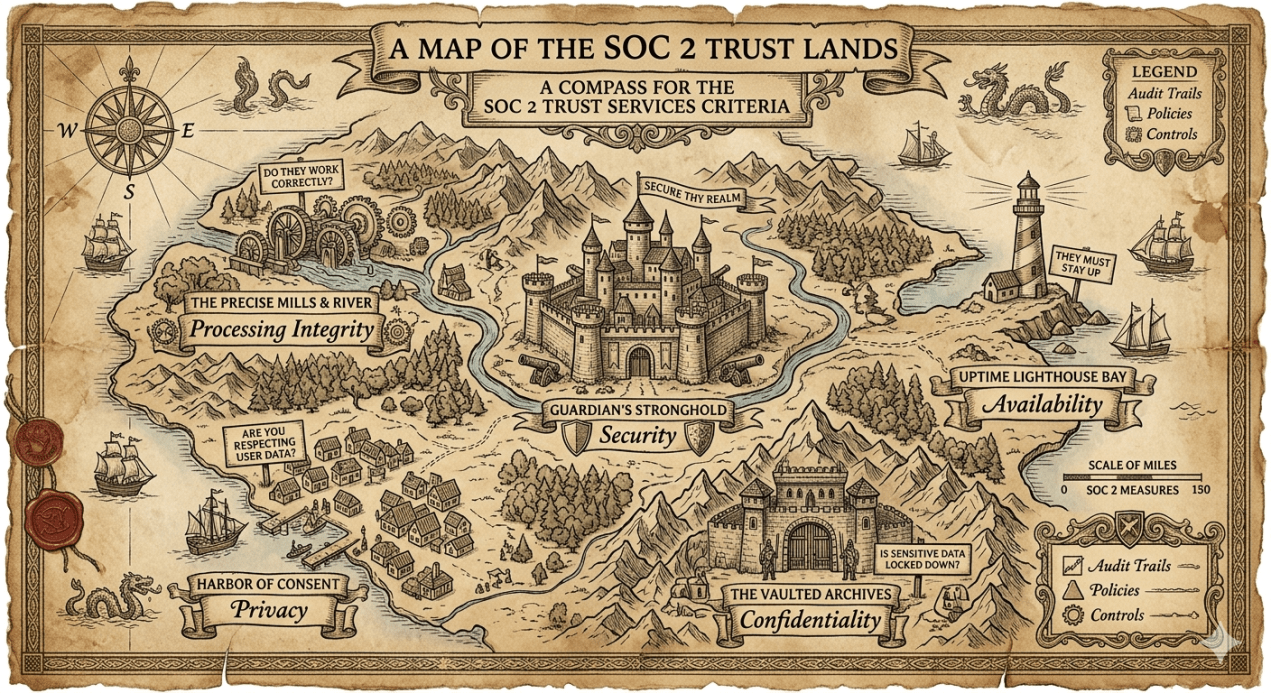
It is a security and trust standard. It proves that your company handles customer data responsibly across five areas:

  • Security – are your systems actually protected?
  • Availability – do they stay up?
  • Processing integrity – do they work correctly?
  • Confidentiality – is sensitive data locked down?
  • Privacy – are you respecting user data?

It’s not a checklist.
It’s an audit.
An external firm comes in and validates that you’re not just saying you’re secure—you actually are.

Why it matters

SOC 2 isn’t about compliance.
It’s about trust at scale.

Continue reading
Standard
AI, Business

Agentic AI in Cybersecurity: Navigating 2026’s Risks and Rewards for SMBs

In 2026, something subtle but powerful is happening in cybersecurity.
Software is no longer just tools.
It’s becoming workers.

AI agents now monitor logs, patch servers, respond to alerts, triage vulnerabilities, and even write remediation scripts. According to Gartner, by the end of this decade a large percentage of enterprise software will include autonomous or semi-autonomous agents.

For large enterprises, that’s exciting.
For SMBs?
It’s both a massive opportunity and a brand new attack surface.

The question is no longer “Should we use AI?”
The real question is:
How do we use agentic AI safely without creating a security nightmare?

Let’s dig in.

Continue reading
Standard
AI, bots, Business

Agentic AI for SMB Cybersecurity

Cybersecurity is becoming impossible for small companies to manage manually.

At the same time, CMMC compliance is no longer optional for companies working with the Department of DefenseWar. Since late 2025, cybersecurity requirements are now embedded directly into DoW contracts, forcing suppliers and subcontractors to prove they can protect sensitive data. (Business Defense)

The problem?

Most SMBs don’t have a security operations center.
They barely have a security engineer.

Meanwhile attackers are moving faster every year.

The good news: AI agents are starting to change the equation.

We’re entering the era of agentic cybersecurity—where autonomous AI systems monitor infrastructure, collect compliance evidence, and respond to threats continuously.

If implemented correctly, this can give small teams enterprise-level security operations with almost no additional headcount.

This post explains:

  1. What “agentic AI” actually means for cybersecurity (and why Claude won’t give it to you with some ‘vibe’)
  2. How it helps with CMMC compliance and real-time threat monitoring
  3. The risks you must design around
  4. A simple architecture you can build today
  5. How platforms like EspressoLabs (with the Barista AI) fit into this shift
Continue reading
Standard
webdev, JavaScript

Building PowderCast: The Ultimate Open Source Weather App for Snowboarders 🏂

If you know me, you know I love two things: writing code that solves real problems, and shredding fresh powder.

For years, I’ve been frustrated with generic weather apps. You know the struggle – the app says “partly cloudy and 30°F” for the town near the resort, but when you get to the summit, it’s a whiteout with 50mph gusts and wind-hold on every lift.

The delta between “base village weather” and “summit weather” can be the difference between the best day of your season and a frostbitten disaster.

So, I did what any engineer would do:

I built my own solution: PowderCast.

Continue reading
Standard
AI, Business

OpenClaw: Redefining Productivity with Autonomous Skills

OpenClaw isn’t interesting because it chats.
It’s interesting because it acts.

If you haven’t internalized that yet, you’re still thinking in “LLM as assistant” mode. OpenClaw is closer to a junior operator with insomnia and root access.
In early 2026, the ecosystem around OpenClaw (which evolved from Clawdbot and Moltbot) has exploded with community-built “skills.” The real shift? These skills run locally and have a heartbeat. They wake up. They check things. They move.

Let’s break down the most popular ones — and more importantly, how to actually build and use them without turning your machine into a chaos engine.

Continue reading
Standard
AI, webdev

Maximize Productivity in Your Codebase with gemini-cli

If you’ve ever opened a legacy project and felt your soul briefly leave your body, this one’s for you.

You know the scene:

  • 200k+ lines of code
  • Three architectural “eras” living in the same repo
  • Tests that pass… somehow
  • A PR review queue that feels like airport security

Let’s fix that.

This post is a practical, hands-on guide to using gemini-cli as a serious productivity multiplier — not as a gimmick, not as a toy, but as a real engineering tool you can plug into your daily workflow today. Btw, I’m not ‘with’ Google for many years now… so it’s all my personal thoughts.

By the end, you’ll know exactly how to:

  • Explore massive codebases without losing your mind
  • Refactor safely and confidently
  • Pre-review your own PRs
  • Generate useful tests (not garbage)
  • Debug failures faster
  • Automate repetitive dev work
Continue reading
Standard
AI, Business

Why Claude’s Code Security Offering Doesn’t Replace Real SMB Cybersecurity

There’s been a lot of noise lately about AI (=Claude Code Security) replacing large chunks of cybersecurity.

Let’s slow down and separate what AI is actually good at from what actually keeps small and mid-sized businesses safe.

AI tools that scan code?
Impressive.

AI that reads configs and flags obvious misconfigurations?
Useful.

AI that can reason over static artifacts and suggest fixes?
Absolutely real progress.

But here’s the uncomfortable truth: most SMBs are not losing sleep over static code scanning.

They’re losing sleep over this:

  • “Why did our Microsoft 365 tenant just send 8,000 phishing emails?”
  • “Why is our bookkeeper’s laptop beaconing to an IP in Eastern Europe?”
  • “Why did our backup silently fail for 12 days?”
  • “Why did we pass compliance last quarter and now suddenly we don’t?”

That’s where EspressoLabs lives.

LLMs are extraordinary pattern recognizers.
They are very good at analyzing text, code, logs — when you give them the data in a clean, structured way. But SMB security isn’t clean. It’s messy, inconsistent, human, political, and operational.

EspressoLabs provides value in places LLMs simply cannot operate — at least not yet:

Continue reading
Standard
Business, webdev

Stay Ahead of Cyber Threats with CISA Advisory Monitor

Here’s a boring truth:
Cybersecurity and Infrastructure Security Agency publishes critical cybersecurity advisories.

Here’s a less comfortable truth:
Most teams never check them.

CISA maintains the Known Exploited Vulnerabilities (KEV) catalog. These are not “theoretical risk under certain lab conditions” bugs. These are vulnerabilities attackers are actively exploiting in the wild, right now, against real systems.

When something lands in KEV, it’s not a polite suggestion. It’s a flare in the sky that says: patch this, or prepare for visitors.

And yet—no one wakes up thinking, “Before coffee, let me refresh a federal website.”

We’re building product.
We’re shipping features.
We’re arguing in Slack.
We’re trying to remember where that one Terraform variable is defined.

So I built a bot that does the refreshing for us.

Continue reading
Standard
Business

CMMC Compliance: Why It Matters for Your Business

It’s not easy early in the morning… but let’s talk about CMMC.

If you work with the Department of Defense—or want to—you’ve probably had one of these moments:

  • “Wait, we need how many controls?”
  • “Is this just NIST 800-171 with extra paperwork?”
  • “Can’t we just say we’re secure?”

Short answer: no.
Long answer: definitely no.

What CMMC Really Is (Without the Buzzwords)

CMMC (Cybersecurity Maturity Model Certification) is the DoD’s way of saying:

“If you want access to our contracts, prove you can protect Controlled Unclassified Information (CUI).”

It formalizes what many companies should have been doing already:

  • Enforcing strong access controls
  • Logging and monitoring activity
  • Managing vulnerabilities
  • Hardening endpoints
  • Applying real security policies (not just a PDF in SharePoint)

In other words: operational cybersecurity, not theoretical cybersecurity.

Continue reading
Standard
life, Sport

Optimize Your Murph Challenge Experience with This Tracker

The Murph Challenge isn’t a workout.
It’s a systems failure conducted at heart-rate redline.

If you’ve ever tried to remember whether you’re on rep 183 or 193 of squats while your lungs are filing a formal complaint, you already know: human memory is not a reliable datastore under load.

So I built a Murph tracker that does exactly one job well—count reps—while I focus on the important things, like not dying.

🎖️ What is Murph (and why people keep doing it)

The Murph Challenge is performed on Memorial Day to honor Lt. Michael P. Murphy, a Navy SEAL killed in Afghanistan in 2005.

It was his favorite workout. Originally named “Body Armor”, which feels accurate in the same way “production incident” feels accurate.

The canonical version:

  • 1 mile run
  • 100 pull-ups
  • 200 push-ups
  • 300 squats
  • 1 mile run

Optional difficulty modifier: wear a 20 lb vest and rethink your life choices.

Continue reading
Standard