Physical legal documents dissolving into digital code and holographic interface on an office desk
AI, Business

AI and Compliance: The Most Boring Billion-Dollar Opportunity Nobody Is Talking About

The US compliance sector is massive, expanding rapidly, and heavily strained. It represents over $40 billion in annual labor spend with more than 400,000 officers. Despite ballooning teams, compliance work has remained stubbornly manual, bureaucratic, and paper-based (“schlep work”), leading to high employee churn (>20%) and massive backlogs (e.g., TD Bank’s $3B fine over a 70,000-alert backlog).

Here’s a weird data point:
Over the last 20 years, the fastest-growing occupation in the US was manicurists and pedicurists.

Right behind it?
Compliance Officers.

Not AI engineers. Not data scientists. Compliance officers.
That says something important about where the real work has been hiding.

The Problem Nobody Wanted to Solve

Compliance is painful. Bureaucratic. Paper-heavy. Repetitive.

Continue reading
Standard
Fiery streams of data converting into a green neural network grid
AI, Business

Using LLMs to Find Security Bugs: A Practitioner’s Playbook

TL;DR

LLMs won’t replace AppSec.
They will dramatically compress the search space.

If you use them right:

  • Run multi-model analysis (Opus + GPT + Gemini)
  • Structure prompts around attack surfaces, not “find bugs”
  • Require PoCs or tests for validation
  • Trust only cross-model consensus or reproducible exploits

If you don’t do this, you’ll drown in false positives.


Security research has always been asymmetric.
Attackers need one bug; defenders need zero.
Historically, scale worked against defenders.

LLMs start to rebalance that—not by magically finding zero-days, but by acting as a fast, always-on analyst that can:

  • Read entire subsystems in seconds
  • Connect logic across files
  • Generate realistic attack paths

Used correctly, they don’t replace expertise—they let you spend it where it matters.
Used incorrectly, they produce confident nonsense.
This is a practitioner’s workflow that actually works.

Continue reading
Standard
Holographic woman labeled AI AGENT leaps through futuristic city with text NEW WORLD GATEWAY.
AI, Business

Anthropic Accidentally Leaked the Blueprint for AI Coding Agents

Or as Elon said “Anthropic is now officially more open than OpenAI“. On this fine April Fools’ Day, the joke isn’t that AI is replacing developers. The joke is that the playbook for doing it just… slipped onto the internet.

Anthropic didn’t intend to publish a step-by-step manual for building AI coding agents.
But through a mix of repos, prompts, and system design breadcrumbs, they effectively did exactly that.

The TL;DR or Key Takeaways from Claude Code’s Source:

  1. Prompts in source code: Surprisingly, much of Claude’s system prompting lives directly in the codebase — not assembled server-side as expected for valuable IP.
  2. Supply chain risk: It uses axios (recently hacked), a reminder that closed-source tools are still vulnerable to dependency attacks.
  3. LLM-friendly comments: The code has excellent, detailed comments clearly written for LLMs to understand context — a smart practice beyond just AGENTS.md files.
  4. Fewer tools = better performance: Claude Code keeps it lean with under 20 tools for normal coding tasks.
  5. Bash Tool is king: The Bash tool stands out, with heavy deterministic parsing to understand and handle different command types.
  6. Tech stack: Entirely TypeScript/React with explicit Bun bindings.
  7. Not open source: The source is “available” but still proprietary. Do not copy, redistribute, or reuse their prompts — that violates the license.

Overall impression:

  • It’s a very well-organized codebase designed for agents to work on effectively.
  • Human engineering is visible, though some parts (like messy prompt assembly) feel surprisingly low-level for Anthropic.
  • The fact that core prompts ship in the CLI tool itself is the biggest surprise.

Let’s take a step back… It is all started with this:

Continue reading
Standard
AI, Business

Agentic AI in Cybersecurity: Navigating 2026’s Risks and Rewards for SMBs

In 2026, something subtle but powerful is happening in cybersecurity.
Software is no longer just tools.
It’s becoming workers.

AI agents now monitor logs, patch servers, respond to alerts, triage vulnerabilities, and even write remediation scripts. According to Gartner, by the end of this decade a large percentage of enterprise software will include autonomous or semi-autonomous agents.

For large enterprises, that’s exciting.
For SMBs?
It’s both a massive opportunity and a brand new attack surface.

The question is no longer “Should we use AI?”
The real question is:
How do we use agentic AI safely without creating a security nightmare?

Let’s dig in.

Continue reading
Standard
AI, bots, Business

Agentic AI for SMB Cybersecurity

Cybersecurity is becoming impossible for small companies to manage manually.

At the same time, CMMC compliance is no longer optional for companies working with the Department of DefenseWar. Since late 2025, cybersecurity requirements are now embedded directly into DoW contracts, forcing suppliers and subcontractors to prove they can protect sensitive data. (Business Defense)

The problem?

Most SMBs don’t have a security operations center.
They barely have a security engineer.

Meanwhile attackers are moving faster every year.

The good news: AI agents are starting to change the equation.

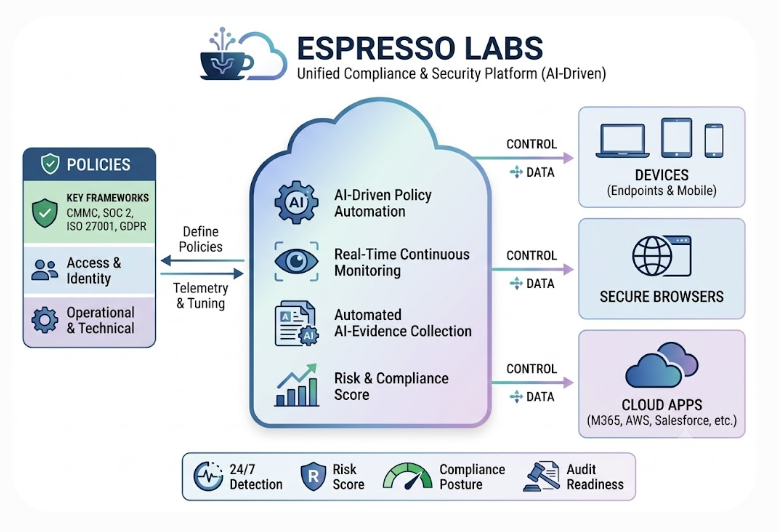
We’re entering the era of agentic cybersecurity—where autonomous AI systems monitor infrastructure, collect compliance evidence, and respond to threats continuously.

If implemented correctly, this can give small teams enterprise-level security operations with almost no additional headcount.

This post explains:

  1. What “agentic AI” actually means for cybersecurity (and why Claude won’t give it to you with some ‘vibe’)
  2. How it helps with CMMC compliance and real-time threat monitoring
  3. The risks you must design around
  4. A simple architecture you can build today
  5. How platforms like EspressoLabs (with the Barista AI) fit into this shift
Continue reading
Standard