Business

Compliance Is Not a Tax. It’s a Sales Accelerator

Most founders treat compliance as a necessary evil — somewhere on the spectrum between filing taxes and getting a root canal. You spend three months scrambling for an audit, pay consultants thousands of dollars, take endless screenshots, answer 200 questions, receive a shiny PDF… and instantly forget about it until next year.

That’s completely backwards.

The best engineering and GTM teams don’t build compliance because an auditor asked for it. They build it because customers buy faster when they trust you.

When you stop treating SOC 2, ISO 27001, HIPAA, or CMMC as part of your IT maintenance budget and start treating them as core go-to-market features, your sales velocity changes overnight.

The Hidden Tax: The 24-Day Black Hole

Every startup optimizes for engineering velocity. Founders obsess over CAC, LTV, net retention, and burn rate. Then, a $250k enterprise deal hits a wall:

“Our InfoSec team just has a few quick questions before procurement can sign.”

Three weeks later, your lead architect is still filling out Question #147 of a security questionnaire that looks like it escaped Microsoft Excel in 2004.

[ Demo Approved ] ➔ [ Technical Validation ] ➔ [ Pricing Agreed ] ➔ [ SECURITY REVIEW ] ➔ [ Closed Won? ]
( Deals go here to die )

Meanwhile:

  • Your internal champion is losing momentum.
  • Legal is raising new red flags.
  • The quarter is closing.
  • Your competitor — whose product is objectively worse, but who has a clean Trust Center — looks like the safer choice.

The product didn’t lose the deal. The security review did.

Smart Action #1: Track Your Security Review Duration (SRD)

Stop measuring just your total sales cycle. Start tracking:

Date the security questionnaire is received.
Date the final security approval is granted.
Total number of clarification rounds.

If your average security review takes 24 days and you close 40 enterprise deals a year, you are wasting nearly three years of cumulative selling time every 12 months. That isn’t an IT metric; it’s a top-line revenue metric.

Compliance Isn’t Security (And That’s Okay)

Here is a truth that makes security purists uncomfortable: Compliance does not equal security.

Compliance improves security, but that isn’t why buyers demand it. Buyers ask for SOC 2 or ISO certifications to transfer and manage risk.

Buying software from a 15-person startup is terrifying for an enterprise VP. Buying software from a 15-person startup that has documented controls, continuous evidence collection, automated access reviews, enforced MFA/SSO, encrypted backups, and a public Trust Center?

Now you look like an enterprise vendor. Your team size matters less; your operational maturity matters more.

Two Mindsets: The Tax vs. The Engine

Model 1: The Tax (Reactive)

[ Customer Demands SOC 2 ] ➔ [ Fire Drill ] ➔ [ Screenshots ] ➔ [ Audit Passed ] ➔ [ Forgotten for 11 Months ]

Model 2: The Sales Engine (Proactive)

[ Automated Evidence ] ➔ [ Live Trust Center ] ➔ [ Instant Questionnaire Response ] ➔ [ Deal Closes Fast ]

Model 1: The Tax

A customer demands SOC 2. Everyone panics.
The team hires expensive consultants, creates 40-page PDF policies nobody reads, collects manual screenshots, and uploads evidence to a shared drive. The audit passes, everyone celebrates, and nothing changes. Nine months later, the seasonal panic repeats.

Model 2: The Sales Engine

The team asks: “How do we make our infrastructure so transparent that we become the easiest vendor to approve?”

Compliance becomes core developer enablement:

  • Security documentation is pre-indexed and ready.
  • Evidence collection runs via automated APIs.
  • Policies live as code.
  • Sales answers security blockers before the prospect even asks.

Smart Action #2: Map the Top 10 Blockers

Ask your sales reps today: “What are the top 10 security questions that slow down your deals?”

If engineering hasn’t pre-built automated proof or standardized responses for those 10 items, you are prioritizing the wrong backlog items.

Real-World Impact: The Healthcare SaaS Case

A SaaS client selling into healthcare had strong product-market fit. Every pilot went smoothly, and clinical teams loved the product. Yet their average deal cycle dragged on for 9 months.

The bottleneck wasn’t pricing or integrations — it was security review repetition. Every hospital security team asked identical questions about data encryption, HIPAA logs, and access revocation. The engineering team was answering every questionnaire from scratch.

The Fix

  • Installed automated evidence collection directly connected to AWS and GitHub.
  • Launched a self-serve Trust Center behind an automated NDA.
  • Standardized an architecture and security whitepaper.

The Result

MetricBeforeAfterImpact
Questionnaire completion time14 daysUnder 48 hours~85% faster
Average enterprise sales cycle9 months3.5 months📈 >60% shorter
Engineering distractionReduced by ~80%🎯 80% reclaimed capacity

The Strategic Trade Off Matrix

StrategyUpfront CostSales VelocityOperational PainSecurity Posture
Ignore Compliance$0🔴 Very Slow🔴 Severe🔴 Weak
Reactive / Annual AuditsLow ($$)🟡 Moderate🟡 High (season tax)🟡 Point-in-time
Continuous ComplianceMedium ($$$)🟢 Very Fast🟢 Low🟢 Real-time

The “expensive” continuous option consistently turns out to be the cheapest path once you factor in saved developer hours and accelerated deal closures.

Build a Trust Center Before You Need One

A Trust Center is one of the highest-leverage, lowest-effort assets an engineering team can ship. Instead of emailing attachments back and forth, you publish a single link containing your security posture.

Core Assets for Your Trust Center

  • Current SOC 2 Type II / ISO 27001 reports (behind automated NDA)
  • System architecture & data flow diagrams
  • Subprocessor list & data residency details
  • Penetration test executive summaries
  • Status page & incident history
  • Continuous compliance monitoring badging

Smart Action #3: The 5-Minute Procurement Test

Pretend you are an enterprise procurement officer. Visit your own website. Can you answer these questions in under 5 minutes without booking a call?

  • Where is customer data hosted and encrypted?
  • How are access permissions revoked upon employee termination?
  • What is your incident response SLA?
  • Do you enforce MFA across all internal services?

If you can’t, your prospective customers can’t either.

Leverage AI Without Sacrificing Trust

Modern AI tools have shifted the economics of compliance.

What AI does well: Drafting initial policy frameworks, mapping existing infrastructure code to control frameworks, auto-filling legacy questionnaires from a verified knowledge base, and parsing incoming vendor security documents.

What stays human: Control ownership, architectural sign-offs, and third-party auditor verification.

Use AI to eliminate the administrative grunt work so your senior engineers can focus on building actual product features.

The 15-Minute Espresso Break Challenge ☕

Pick one open enterprise deal currently sitting in your team’s pipeline and run through this checklist:

  • Can your account executive send a prospective buyer a complete security package in under 60 seconds?
  • Is your most recent penetration test summary less than 12 months old?
  • Are your infrastructure access reviews running automatically on a 90-day cycle?
  • Do you have pre-approved responses ready for the top 10 security questions?

If you checked fewer than 3 boxes, your next competitive advantage isn’t a new product feature — it’s fixing your security pipeline friction.
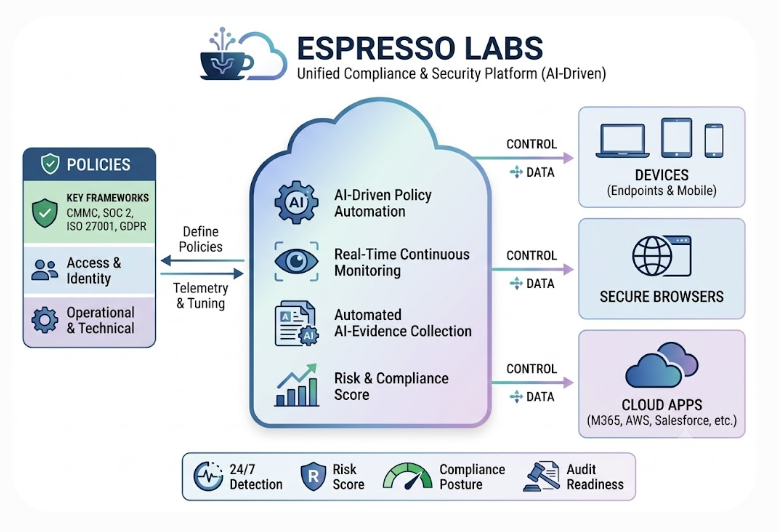
Ahh… check EspressoLabs platform as it was built from the start to help you wish these challenges.

Standard
Business

Understanding the CMMC Pause: Key Changes and Action Steps

On July 13, 2026, the Department of War announced the immediate suspension of CMMC Phase II requirements. The move was memorialized in a memo dated July 10, 2026, signed by DoW Chief Information Officer Kirsten Davies. Those requirements had been scheduled to take effect on November 10, 2026, and would have pushed many contracts handling Controlled Unclassified Information (CUI) into mandatory third-party C3PAO assessments.

The stated goal is straightforward: reduce compliance barriers for small, medium, and non-traditional businesses so the Defense Industrial Base can expand faster under the Department’s current acquisition priorities.
A 60-day CMMC Reform Task Force review is now underway, including a public Request for Information seeking industry input on cost drivers and administrative burden. Phase I self-assessment requirements remain firmly in place.

This is not a free pass.
It’s a pause on one layer of bureaucracy — not a suspension of the underlying security obligations.

What Actually Changed (and What Didn’t)

Suspended

  • The November 2026 transition to Phase II — third-party Level 2 assessments as a condition of award in many cases.
  • Pending and future CMMC implementation milestones (including Phase III and IV) that would have required C3PAO or DIBCAC assessments.
  • During the review period, contracting officers are limited to requiring only Level 1 (Self) or Level 2 (Self) assessments in new procurements.
  • Existing contracts that already contain Phase II language will have that language removed by modification, either before the next option period or at the next scheduled administrative update.

Still fully in force

  • Phase I self-assessments and annual affirmations in SPRS.
  • DFARS 252.204-7012 obligations to protect covered defense information and implement NIST SP 800-171 controls.
  • Contractual cybersecurity requirements that primes flow down to subcontractors.
  • The Department of Justice’s Civil Cyber-Fraud Initiative, which continues to treat inaccurate self-assessments and false claims seriously.

The official release is worth reading in full: Forging the Arsenal of Freedom: Department of War Suspends CMMC Phase II Requirements. The SBA has also publicly backed the move, arguing the prior framework was pushing small firms out of the defense supply chain.

In short: the certification theater got paused. The requirement to actually protect the data did not.

Continue reading
Standard
Business

GRC Platforms vs. Managed Compliance: Understanding the Gaps

TL;DR

A GRC platform tells you where you stand. A managed compliance service (in theory) does the standing-up.
Before you sign either contract, make someone in the room answer this out loud:
when a control fails at 2 a.m., who fixes it, how fast, and how do we know it actually happened?
If nobody can answer that today, that’s the gap you’re actually buying a solution for — not the framework name on the badge.

Btw, If the 2 a.m. question above didn’t have a clean answer, it’s worth a look at what a fully managed model covers versus what’s still sitting on your team’s plate. Check out the Espresso Labs platform


If you’ve bought a GRC (governance, risk management, and compliance) tool in the last five years, you’ve probably had this moment: the dashboard is green, the auditor is happy, and yet you still have an unencrypted laptop sitting in someone’s bag, a service account with a password from 2021, and a patch cadence that only exists on paper. The tool told you the truth. It just didn’t fix anything.

That gap — between visibility and operationalization — is worth thinking about carefully, because it’s where a lot of compliance budget quietly goes to die.

What GRC platforms like Vanta and Drata actually solve

Vanta and Drata deserve real credit. They replaced the compliance shared-spreadsheet — the one where “evidence” meant a screenshot pasted into a folder six weeks before the audit. What they do well:

  • Pull control status from the tools you already run via read-only integrations
  • Map passing/failing checks to a framework (SOC 2, ISO 27001, HIPAA, CMMC, etc.)
  • Automate evidence collection so audit season isn’t a fire drill
  • Alert you when something drifts out of policy

For a company with a mature security function — people who own EDR, MDM, SSO, backup, and vulnerability management day to day — this is exactly the layer you want. It turns “prove you’re compliant” from an annual archaeology project into a live, queryable system.

The quiet assumption baked into that model

Here’s the thing these platforms assume, and it’s almost never stated out loud in the sales process: you already have the underlying security program.

The dashboard reports on controls; it doesn’t implement them, enforce them, or fix them when they break.

When Vanta flags an unencrypted disk, or Drata flags a stale account, that finding lands in a queue. Someone — on your team, or a vendor you’ve separately hired — has to:

  1. Triage it
  2. Actually go fix it (device by device, user by user)
  3. Confirm the fix took
  4. Make sure it doesn’t regress next sprint

For a company with a five-person security team and a mature IT function, that’s Tuesday. For the median SMB or mid-market company — the ones without a dedicated security engineer, running IT through an MSP or a stretched-thin generalist — that queue just grows. You end up with excellent visibility into a program that isn’t actually being run.

This is also why “we’re SOC 2 compliant” and “we’re actually secure” are not the same sentence. A dashboard can be green because your controls are well-enforced, or it can be green because someone knows exactly which checkboxes the auditor samples. Both look identical from the dashboard.

Continue reading
Standard
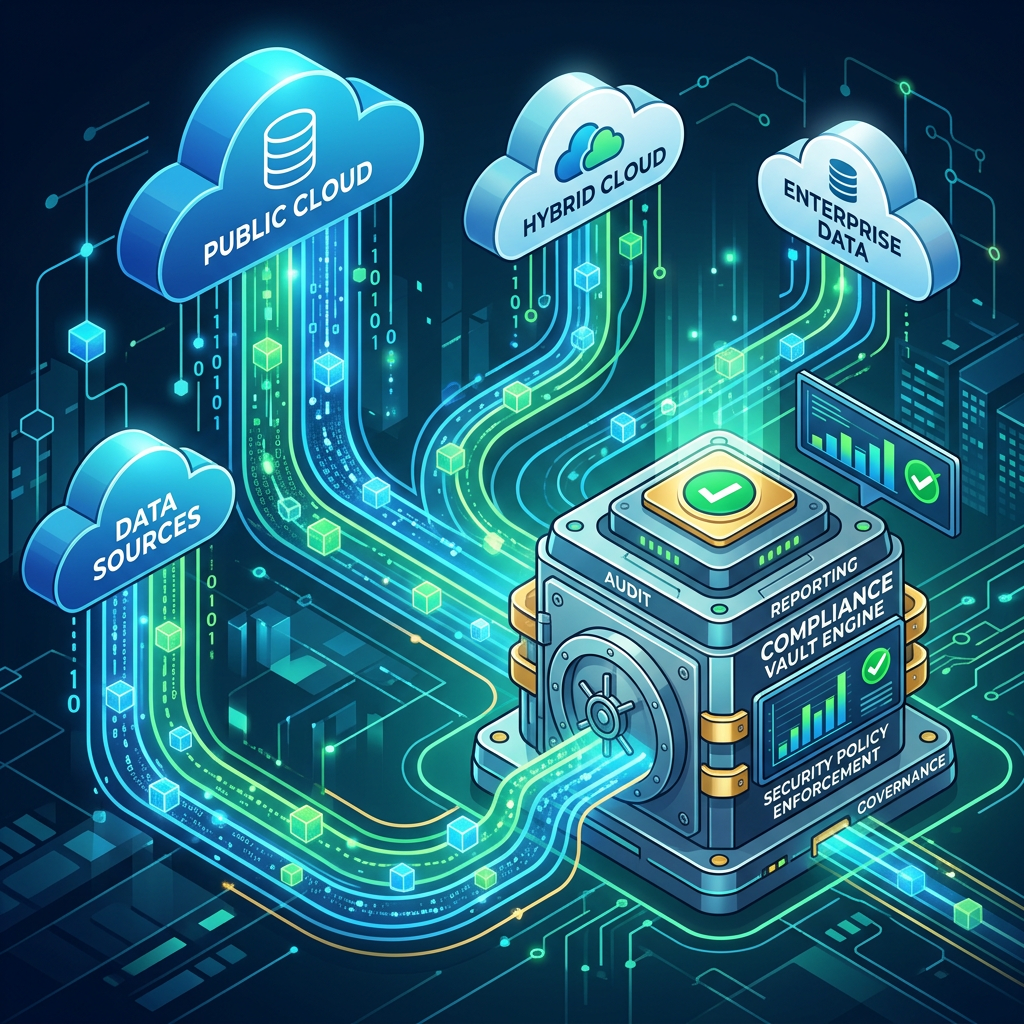
Secure data streams from public, hybrid, enterprise cloud, and data sources into a compliance vault engine
AI, Business

Automating the Audit Trail: How I Built a GitHub Screenshoter for Zero-Friction SOC 2 Compliance

It’s audit season. And if you’re a SaaS startup, you know exactly what that means.
The dreaded “Change Management” evidence request.

Some auditor sends you a list of 15 random commit SHAs from your production branch and says: “Prove to me that every single one of these was reviewed, approved, and linked to a ticket.”

Your heart sinks.

You know you’re about to spend the next four hours of your life doing the most mind-numbing task in tech: opening GitHub, finding the commit, taking a screenshot, finding the PR, taking a screenshot, finding the issue, taking a screenshot, and pasting it all into a PDF.

It’s manual. It’s painful. And it’s a complete waste of engineering time.

So, I built a tool to kill this pain once and for all: GitHub Screenshoter.

Continue reading
Standard
AI, Business

Building a CMMC Readiness Calculator That People Can Actually Finish

Most compliance tools look great in screenshots.

Far fewer are useful on a random Tuesday afternoon when someone in operations, IT, or leadership is trying to answer a simple question:

“How ready are we, really?”

That’s the problem we set out to solve.

Not certification.
Not auditing.
Not replacing consultants.

Just helping defense contractors get a realistic picture of their CMMC readiness before investing weeks of meetings, spreadsheets, and assessment calls.

The result is a simple CMMC Readiness Calculator that turns a short questionnaire into:

  • an estimated readiness score
  • an estimated SPRS score
  • a count of missing or partially implemented controls
  • a three-year compliance cost projection
  • a comparison between traditional and managed compliance approaches

Nothing magical.
Just useful.

Continue reading
Standard
Futuristic cockpit with holographic compliance and cybersecurity monitoring dashboard
AI, Business

CMMC Certification Cost: How AI-Native Compliance Can Cut Expenses by over 70%

If you’re pursuing CMMC certification, one of the first questions you’ll ask is:

How much does CMMC certification cost?

The answer depends on your current security posture, the size of your organization, and how you approach compliance. For many small and mid-sized businesses, the total cost of achieving and maintaining CMMC Level 2 compliance can range from tens of thousands to hundreds of thousands of dollars.

The surprising part?

The audit itself is rarely the biggest expense.

Continue reading
Standard
Physical legal documents dissolving into digital code and holographic interface on an office desk
AI, Business

AI and Compliance: The Most Boring Billion-Dollar Opportunity Nobody Is Talking About

The US compliance sector is massive, expanding rapidly, and heavily strained.
It represents over $40 billion in annual labor spend with more than 400,000 officers. Despite ballooning teams, compliance work has remained stubbornly manual, bureaucratic, and paper-based (“schlep work”), leading to high employee churn (>20%) and massive backlogs (e.g., TD Bank’s $3B fine over a 70,000-alert backlog).

Here’s a weird data point:
Over the last 20 years, the fastest-growing occupation in the US was manicurists and pedicurists.
Right behind it?
Compliance Officers.

Not AI engineers. Not data scientists. Compliance officers.
That says something important about where the real work has been hiding.

The Problem Nobody Wanted to Solve

Compliance is painful. Bureaucratic. Paper-heavy. Repetitive.

Continue reading
Standard
AI, Business

Why SMBs Struggle with Cybersecurity: The Real Challenges

I recently had a conversation on The Changelog, and it reinforced something I’ve seen over and over again:

SMB cybersecurity isn’t just hard — it’s structurally broken.

Not because people don’t care.
Not because tools don’t exist.
Because the entire model assumes resources that SMBs simply don’t have.

The uncomfortable truth

Security today is designed for enterprises and downsized for everyone else.
That doesn’t work.
Enterprise model:

  • Dedicated security teams
  • Time to triage alerts
  • Budget to stack tools

SMB reality:

  • One DevOps person wearing five hats
  • Compliance pressure (SOC 2, ISO 27001, CMMC…)
  • A pile of tools that don’t talk to each other

So what happens?

They install more tools…generate more alerts…and end up less certain about their security posture.
That’s the paradox.

Continue reading
Standard
Animated coffee cup with a spoon glowing magical shield against dark fiery monsters
AI, Business

SMB Cybersecurity Is Broken — Here’s What We’re Doing About It

SMB cybersecurity is a mess. Yes – It’s 2026 and it’s broken. Big time.

Too many tools.
Too many dashboards.
Too many alerts that nobody has time—or context—to act on.

And the result?
A false sense of security.

You can have RMM, MDM, EDR, SIEM, compliance tools… and still be exposed. Not because the tools are bad—but because the system is unworkable for the people actually running it.

Most small and mid-sized businesses don’t have a SOC.
They don’t have a dedicated security team.
They don’t have time to interpret 300 alerts a day.

What they have is:

  • An overstretched IT person (or MSP or the owner that is busy with 127 other things that are all urgent)
  • A growing attack surface
  • And a stack of tools that don’t talk to each other

That’s the real gap.

A Quick Look

We recently shared a glimpse of what we’re building here:

Continue reading
Standard
AI, Business

Compliance Is Not a Checkbox – It’s a System

Let’s be honest.
Compliance today is broken for SMBs.
It’s fragmented.
Expensive.
Manual.
And worst of all—reactive.

You buy a few tools.
Hire a consultant.
Fill out some spreadsheets.
Panic before the audit.
Repeat next year.

Meanwhile, the reality has changed:

  • SOC 2 is table stakes
  • CMMC is blocking revenue
  • HIPAA fines are brutal
  • ISO 27001 is becoming expected

And one unsecured laptop can kill a deal.

The Core Problem

Most companies treat compliance like documentation.
It’s not.
It’s continuous enforcement of controls across your entire environment.

That means:

  • Every device encrypted
  • Every patch applied
  • Every user monitored
  • Every control provable—on demand

You can’t fake that with PDFs.

Continue reading
Standard