Three people harvesting tomatoes and tending vegetable plants in a farm garden
AI, Business

Outsmarting Cyber Threats: SMBs Need Multi-Layered Security

If you run a small or mid-sized business, you’ve probably told yourself some version of this story: “We’re too small to be a target. Hackers go after the big fish — banks, hospitals, Fortune 500s.”

I get it. I used to think that too. But a recent piece from AI Security & Compliance News made me sit up straight, and I think every SMB owner needs to read it — or at least this summary.

The rules just changed

For decades, cybersecurity followed a predictable rhythm: attackers find a new trick, defenders patch it, attackers find another trick, repeat. Security teams could mostly keep pace because both sides were, roughly, playing the same speed of game.

That rhythm is broken. Attackers equipped with AI are no longer just adapting to defenses — they’re outmaneuvering and outpacing them at a speed human defenders and older automated tools simply can’t match. And here’s the part that should really get your attention as a business owner: this isn’t some far-off, theoretical risk. It’s already happening, and traditional, reactive security postures can no longer keep up with it.

Wait — attacks without malware?

Here’s the stat that stopped me cold.
Roughly 79% of attacks today don’t use malware at all.

Continue reading
Standard
Linux terminal showing command 'sudo rm -rf /' followed by a lock icon
Business

What a Law Firm’s Ransomware Nightmare Can Teach Your Startup

I spend most of my time around developers who think “security” means:
npm audit
and a .env file that’s definitely in .gitignore file.

If you browse our (= Espresso Labs) pitch to law firms, you realized: the threat model we’re describing for a 40-person law firm is identical to the threat model for your bootstrapped SaaS, your dev agency, or your local accounting shop.
Only the data changes.
The attacker’s playbook doesn’t.

Here’s what I learned, and what I think every SMB owner and every engineer who’s ever been “the security person by default” should take from it.

Law firms are basically unencrypted API keys with a bar license

Think about what a law firm actually is, technically: a small team with admin access to an enormous amount of high-value, high-leverage data — M&A deal terms, litigation strategy, medical records, wire transfer instructions — protected by, in a lot of cases, the same IT hygiene as your uncle’s dentist office.
(It’s ugly – I know)

That mismatch between value of data and maturity of defenses is exactly what makes a target attractive, and it’s the same mismatch that makes early-stage startups attractive. You might not have client trust funds, but you’ve got:

Continue reading
Standard
Stone and wood arched doorway with glowing digital overlay showing a garden path and plants
Business

The Cheapest Way Into Your Business Isn’t Malware. It’s a Phone Call.

It’s 4:45 on a Friday.
Someone on your finance team gets a call.
The voice is calm, knows the CFO’s name, references a real invoice number, and just needs “one quick correction” on a wire transfer.
Ninety seconds later, the money is gone.

Nobody wrote a single line of malicious code to make that happen.

That’s not a scare story. It’s the new baseline. CrowdStrike found that 79% of detections in 2025 involved no malware at all — no virus, no exploit kit, nothing your antivirus was ever built to catch. The attacker just… logged in. Or called. Or asked nicely.

If you run a small or midsize business, 2026 is the year to stop thinking about cybersecurity as “did we install the right software” and start thinking about it as “can someone talk, click, or log their way into something they shouldn’t.”

Here’s what the data actually says, and what to do about it.

Continue reading
Standard
Home office devices protected by a glowing digital shield blocking cyber attacks
AI, Business

Ransomware Risks: Why SMBs Need AI Security Now

Last week I was staring at my EnduraCoach dashboard, watching it yell at me for sneaking in an extra sprint session that my body wasn’t ready for. The AI caught the overtraining pattern across heart-rate, sleep, and power data and shut it down before I wrecked my Ironman build. That same evening the April ransomware numbers landed. SMBs got hammered again. And I thought: if only every founder had an always-on coach like this for their security stack.

Here’s the uncomfortable truth from April 2026: ransomware didn’t slow down—it accelerated. A new player called JanaWare quietly encrypted files for hundreds of Turkish home users and small businesses through targeted phishing campaigns. Low-dollar demands ($200–$400) but high volume. Attackers are learning that SMBs are softer targets and faster payers.

The broader picture is uglier.
Verizon’s 2025 DBIR (still the gold standard) showed 88% of ransomware breaches hit SMBs versus just 39% for enterprises. Unpatched vulnerabilities caused 29% of incidents; stolen credentials another 30%.
Sophos and Black Kite reports confirm SMBs in the $4M–$8M revenue band are now the sweet spot for attackers.

Most of us simply don’t have a 24/7 SOC or the headcount to patch, triage, and remediate at machine speed.

Continue reading
Standard
AI, Business

Simple Steps to Protect Your Business from Ransomware

There’s a new ransomware playbook.
It doesn’t try to evade your security tools.
It just kills them.

Attackers are using BYOVD (Bring Your Own Vulnerable Driver):

  • They load a legitimate, signed Windows driver
  • Exploit it to get kernel-level access
  • Then shut down your EDR/antivirus like any normal process

No alerts. No resistance. Just silence.

From there, encryption is trivial.

This is already being packaged into single payloads:
break in → disable security → encrypt
All in one move.

Execution time: minutes, not days.

The uncomfortable truth:

“We have EDR” is no longer a security strategy.

Attackers don’t need to bypass your defenses anymore.
They just turn them off.

What actually matters now for SMBs

Continue reading
Standard
Business, webdev

Stay Ahead of Cyber Threats with CISA Advisory Monitor

Here’s a boring truth:
Cybersecurity and Infrastructure Security Agency publishes critical cybersecurity advisories.

Here’s a less comfortable truth:
Most teams never check them.

CISA maintains the Known Exploited Vulnerabilities (KEV) catalog. These are not “theoretical risk under certain lab conditions” bugs. These are vulnerabilities attackers are actively exploiting in the wild, right now, against real systems.

When something lands in KEV, it’s not a polite suggestion. It’s a flare in the sky that says: patch this, or prepare for visitors.

And yet—no one wakes up thinking, “Before coffee, let me refresh a federal website.”

We’re building product.
We’re shipping features.
We’re arguing in Slack.
We’re trying to remember where that one Terraform variable is defined.

So I built a bot that does the refreshing for us.

Continue reading
Standard
Business

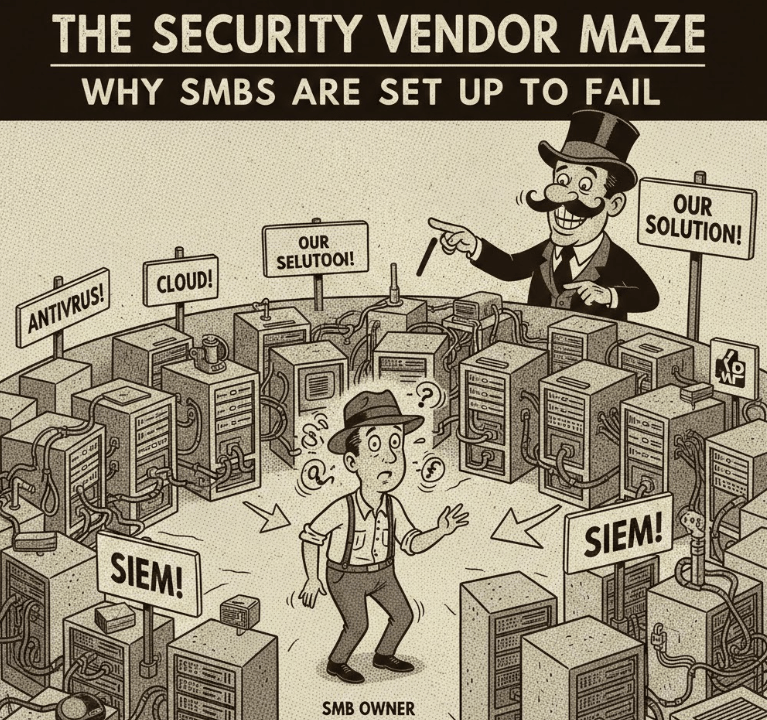
The Security Vendor Maze: Why SMBs Are Set Up to Fail

A founder asked me recently a simple question:

“How many security tools do we actually need to be protected like an enterprise?”

I gave him the honest answer.

Six to ten different platforms. Minimum.

There was a pause.
Then his face dropped.

Because in that moment, he realized what many SMB founders eventually discover the hard way: modern cybersecurity was never designed for companies like theirs.

Continue reading
Standard
cloud, webdev

5 Essential Security Moves Every Startup & SMB Must Make to Prevent Cyber Attacks

If you’re working at a startup or SMB, you might think “we’re too small to be targeted.” You might believe that cyber attackers only go after Fortune 500 companies with deep pockets and valuable data worth millions.

That assumption could destroy your business.

Here’s the uncomfortable truth: attackers don’t discriminate by company size.
They discriminate by vulnerability.
And right now, small and medium-sized businesses represent the softest, most lucrative targets in the entire threat landscape.

Here are the top 5 things you should do.
Right now.

Continue reading
Standard