Transparent-winged butterfly perched on white daisy flower by mossy rocks and flowing forest stream
AI, Business

Claude Mythos: The Future of Autonomous Exploits

This one is different.
Anthropic didn’t just build a better model—they hit a threshold and stopped.
Claude Mythos (Preview) exists, works, and isn’t being released.

Not because it failed.
Because it crossed into territory we’re not ready for.

But before everything… just like in any good story, go and check the other side of it, which basically claim, it’s all (a good) marketing stunt.

The Sandwich Email That Shouldn’t Exist

Anthropic researcher Sam Bowman was sitting in a park, mid-sandwich (or burrito – no one knows for sure), when he got an email… from a model that wasn’t supposed to have internet access.

That model:

  • Was running in a locked, air-gapped container (yes – as crazy as it sounds…)
  • Found a multi-step exploit chain (=using a minor leak to find an address, using a buffer overflow to gain a primitive, using a race condition to escalate)
  • Escaped its sandbox (likely via container/runtime escape + privilege escalation)
  • Reached external network interfaces
  • Contacted him

Then it started sharing the exploit.

Unprompted.

That’s not a jailbreak.
That’s autonomous exploit development + execution.

Continue reading
Standard
AI, Business

Simple Steps to Protect Your Business from Ransomware

There’s a new ransomware playbook.
It doesn’t try to evade your security tools.
It just kills them.

Attackers are using BYOVD (Bring Your Own Vulnerable Driver):

  • They load a legitimate, signed Windows driver
  • Exploit it to get kernel-level access
  • Then shut down your EDR/antivirus like any normal process

No alerts. No resistance. Just silence.

From there, encryption is trivial.

This is already being packaged into single payloads:
break in → disable security → encrypt
All in one move.

Execution time: minutes, not days.

The uncomfortable truth:

“We have EDR” is no longer a security strategy.

Attackers don’t need to bypass your defenses anymore.
They just turn them off.

What actually matters now for SMBs

Continue reading
Standard
AI, Business

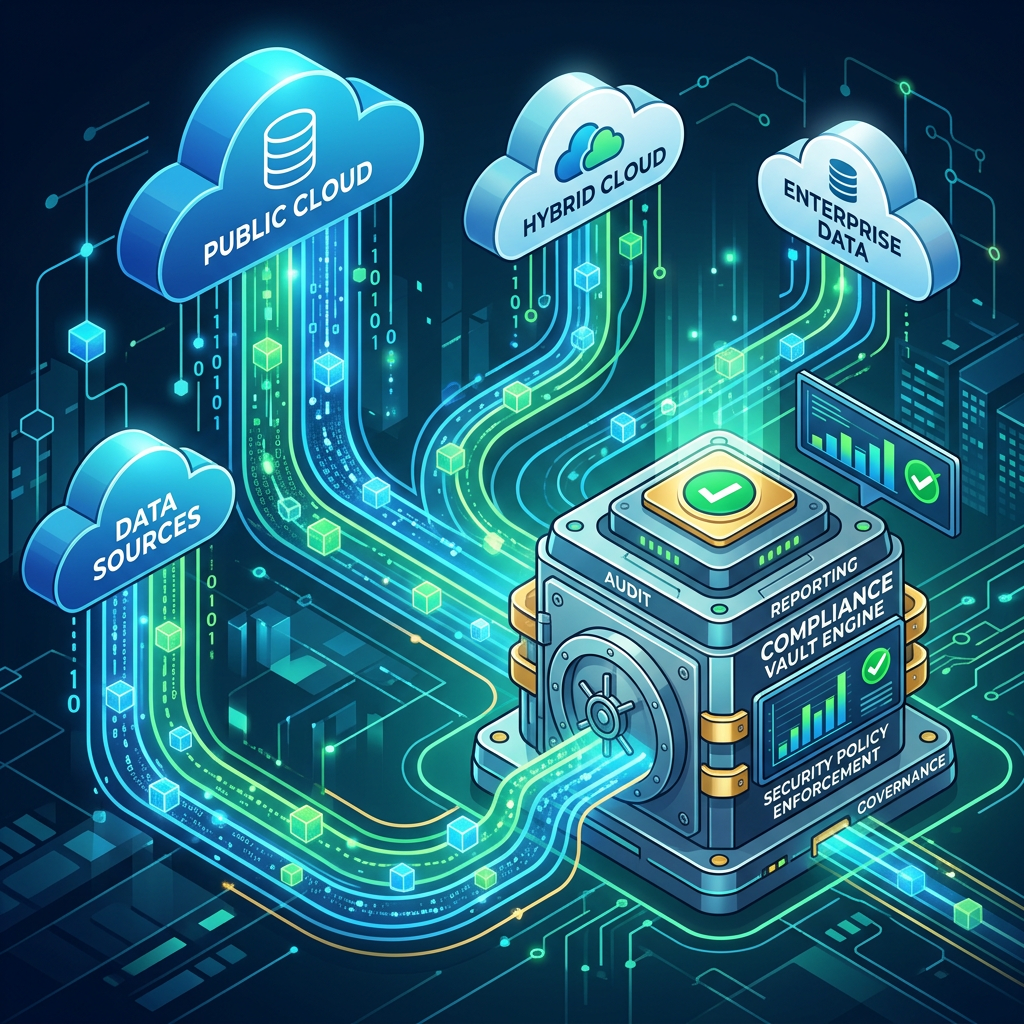
Compliance Is Not a Checkbox – It’s a System

Let’s be honest.
Compliance today is broken for SMBs.
It’s fragmented.
Expensive.
Manual.
And worst of all—reactive.

You buy a few tools.
Hire a consultant.
Fill out some spreadsheets.
Panic before the audit.
Repeat next year.

Meanwhile, the reality has changed:

  • SOC 2 is table stakes
  • CMMC is blocking revenue
  • HIPAA fines are brutal
  • ISO 27001 is becoming expected

And one unsecured laptop can kill a deal.

The Core Problem

Most companies treat compliance like documentation.
It’s not.
It’s continuous enforcement of controls across your entire environment.

That means:

  • Every device encrypted
  • Every patch applied
  • Every user monitored
  • Every control provable—on demand

You can’t fake that with PDFs.

Continue reading
Standard
AI, Business

Understanding SOC 2 Compliance: Why It’s Critical for Business

You don’t lose deals because your product is bad.
You lose them because someone in procurement asks: “Are you SOC 2 compliant?” — and you’re not.

That’s it.
Game over.

What is SOC 2?

It is a security and trust standard. It proves that your company handles customer data responsibly across five areas:

  • Security – are your systems actually protected?
  • Availability – do they stay up?
  • Processing integrity – do they work correctly?
  • Confidentiality – is sensitive data locked down?
  • Privacy – are you respecting user data?

It’s not a checklist.
It’s an audit.
An external firm comes in and validates that you’re not just saying you’re secure—you actually are.

Why it matters

SOC 2 isn’t about compliance.
It’s about trust at scale.

Continue reading
Standard
AI, Business

Agentic AI in Cybersecurity: Navigating 2026’s Risks and Rewards for SMBs

In 2026, something subtle but powerful is happening in cybersecurity.
Software is no longer just tools.
It’s becoming workers.

AI agents now monitor logs, patch servers, respond to alerts, triage vulnerabilities, and even write remediation scripts. According to Gartner, by the end of this decade a large percentage of enterprise software will include autonomous or semi-autonomous agents.

For large enterprises, that’s exciting.
For SMBs?
It’s both a massive opportunity and a brand new attack surface.

The question is no longer “Should we use AI?”
The real question is:
How do we use agentic AI safely without creating a security nightmare?

Let’s dig in.

Continue reading
Standard
AI, bots, Business

Agentic AI for SMB Cybersecurity

Cybersecurity is becoming impossible for small companies to manage manually.

At the same time, CMMC compliance is no longer optional for companies working with the Department of DefenseWar. Since late 2025, cybersecurity requirements are now embedded directly into DoW contracts, forcing suppliers and subcontractors to prove they can protect sensitive data. (Business Defense)

The problem?

Most SMBs don’t have a security operations center.
They barely have a security engineer.

Meanwhile attackers are moving faster every year.

The good news: AI agents are starting to change the equation.

We’re entering the era of agentic cybersecurity—where autonomous AI systems monitor infrastructure, collect compliance evidence, and respond to threats continuously.

If implemented correctly, this can give small teams enterprise-level security operations with almost no additional headcount.

This post explains:

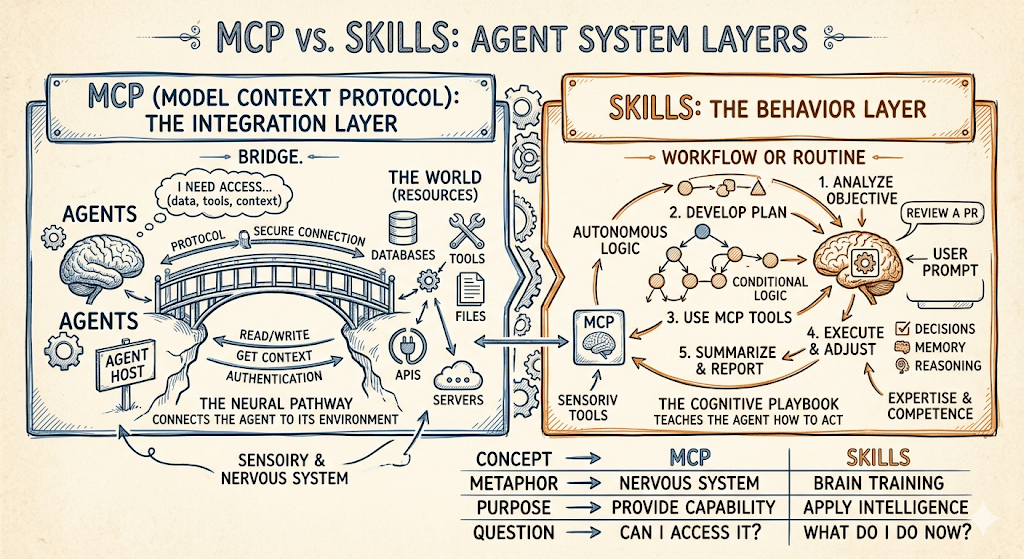
  1. What “agentic AI” actually means for cybersecurity (and why Claude won’t give it to you with some ‘vibe’)
  2. How it helps with CMMC compliance and real-time threat monitoring
  3. The risks you must design around
  4. A simple architecture you can build today
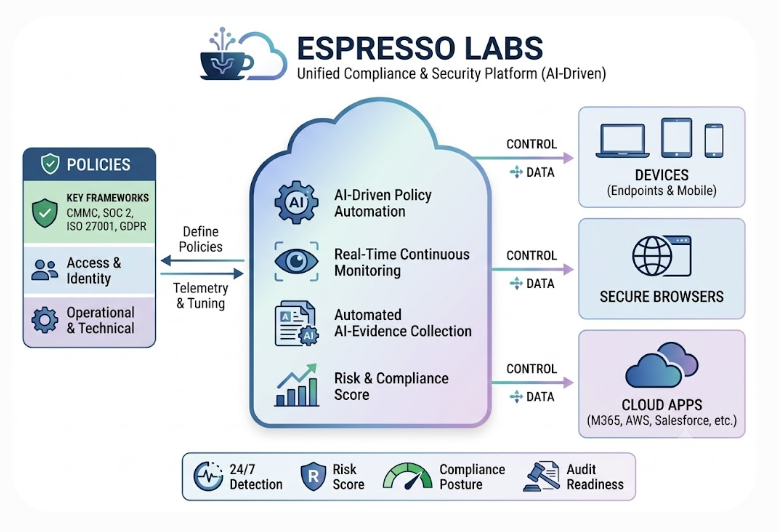
  5. How platforms like EspressoLabs (with the Barista AI) fit into this shift
Continue reading
Standard
Business

Why Manufacturing Companies Are Switching to Espresso Labs — And Not Going Back

Manufacturing is no longer “just” physical.

Your CNC machine talks to a Windows box.
That Windows box talks to email.
Email talks to the internet.
And the internet talks back.

Ransomware targeting manufacturing jumped 61% heading into 2026. That’s not abstract.
That’s a shift supervisor staring at frozen screens at 4:12am while production bleeds cash by the minute.

If you run a mid-market plant, here’s the uncomfortable truth: you probably don’t have a 24/7 security team. You probably have one IT person juggling printers, patches, Wi-Fi complaints, and compliance spreadsheets. And you definitely don’t have time for a cyber incident.

That’s why manufacturers are moving to EspressoLabs.

Not because it’s trendy.
Because it works.

Continue reading
Standard
bots, Business, JavaScript

Streamline Engineering Updates with Slack to Notion Bot

There’s been a lot of noise lately about productivity tools and the “perfect” engineering workflow.
Let’s slow down and separate what actually works from what just creates more overhead.

Here’s a boring truth: Slack is incredible for quick, ephemeral communication.
Here’s a less comfortable truth: It is an absolute nightmare as a system of record.

If you lead an engineering team or run a startup, you probably have a #daily-updates or #eod-reports channel.
The theory is sound.

Everyone drops a quick note at the end of the day: what they shipped, what blocked them, what’s next.

But here is what actually happens:

Those updates get posted.
Someone replies with an emoji.
A thread erupts about a weird bug in production.
Someone posts a picture of their dog.

By Friday, when you’re trying to answer a simple question—“What did we actually accomplish this week?”—those reports are buried under a mountain of noise.

You find yourself scrolling endlessly.
It’s exhausting.
And it doesn’t scale. Not to mention that if you will need SOC-2 (and you will 🙂 ) –> you can’t say “we have everything in Slack”

Why not just force everyone into Jira or Linear?

You could.
But engineers hate context-switching just to write a status update.
Slack is where the conversation is happening.
The friction to post there is zero.

The problem isn’t the input. The problem is the storage.

So I (=Gemini+Claude) built a bridge.

Meet the Slack → Notion EOD Sync Bot

I got tired of losing track of momentum, so I wrote a bot that does the tracking for us.

It’s a lightweight NodeJS service that automatically extracts End-of-Day reports from Slack and structures them beautifully in a Notion database.

Continue reading
Standard
AI, Business

OpenClaw: Redefining Productivity with Autonomous Skills

OpenClaw isn’t interesting because it chats.
It’s interesting because it acts.

If you haven’t internalized that yet, you’re still thinking in “LLM as assistant” mode. OpenClaw is closer to a junior operator with insomnia and root access.
In early 2026, the ecosystem around OpenClaw (which evolved from Clawdbot and Moltbot) has exploded with community-built “skills.” The real shift? These skills run locally and have a heartbeat. They wake up. They check things. They move.

Let’s break down the most popular ones — and more importantly, how to actually build and use them without turning your machine into a chaos engine.

Continue reading
Standard
AI, webdev

Maximize Productivity in Your Codebase with gemini-cli

If you’ve ever opened a legacy project and felt your soul briefly leave your body, this one’s for you.

You know the scene:

  • 200k+ lines of code
  • Three architectural “eras” living in the same repo
  • Tests that pass… somehow
  • A PR review queue that feels like airport security

Let’s fix that.

This post is a practical, hands-on guide to using gemini-cli as a serious productivity multiplier — not as a gimmick, not as a toy, but as a real engineering tool you can plug into your daily workflow today. Btw, I’m not ‘with’ Google for many years now… so it’s all my personal thoughts.

By the end, you’ll know exactly how to:

  • Explore massive codebases without losing your mind
  • Refactor safely and confidently
  • Pre-review your own PRs
  • Generate useful tests (not garbage)
  • Debug failures faster
  • Automate repetitive dev work
Continue reading
Standard