
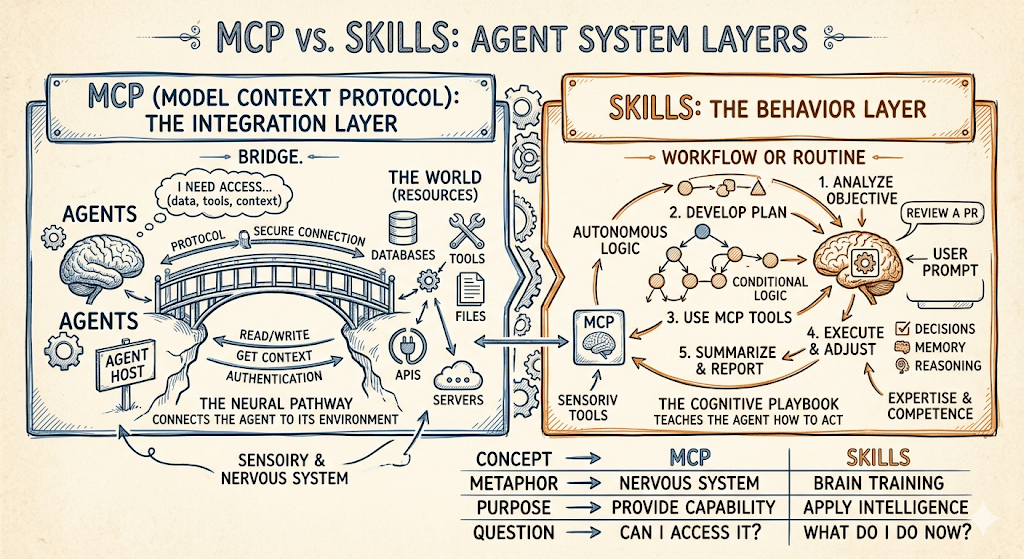
There’s a lot of confusion right now between MCP (Model Context Protocol) and “Agent Skills.” They’re often mentioned in the same breath, but they solve different problems. If you treat them as interchangeable, you’ll either over-engineer simple workflows or underpower serious integrations.
Here’s the clean way to think about it.
The Core Difference
MCP is about connecting agents to systems.
Skills are about teaching agents how to do things.
That distinction alone gets you 80% of the way.
Integration Model
MCP is a client-server protocol. You stand up an MCP server, expose tools, and now multiple agents can talk to multiple backends through a consistent interface. It’s a hub.
Skills are much simpler: a folder with a SKILL.md file. The agent loads it when triggered and follows the instructions. No protocol, no network layer, no abstraction.
Implication:
- MCP scales across teams and services
- Skills scale across use cases and workflows
Architecture
MCP runs as a separate process with its own runtime, typically speaking JSON-RPC. It’s a real service—versioned, deployed, monitored.
The MCP mindset: “How do I give my agent access to the documents, tools, and databases it needs to see what’s happening?”
MCP is your Integration Layer:
- Universal Connectivity: An agent built with MCP support can instantly connect to any MCP-compliant server. If a new vector database, a CRM, or a local file parser releases an MCP server, your agent can integrate it without you writing a single line of new integration code.
- Context-Aware Data Access: MCP isn’t just about calling functions; it’s about providing the agent with the context it needs. The protocol allows the agent to query local repositories, read files, and browse databases securely. This transforms the agent from a static model into a system aware of its environment.
- Security and Control: The MCP host application (the part running the agent) maintains control. It decides which servers are available, which prompts are permitted, and which tools can be executed. This is critical for building “serious” systems where you cannot simply give an LLM unfettered access to your entire network.
A Skill is just a directory:
SKILL.md(the brain)- optional scripts (bash, Python, etc.)
- references or assets
No runtime. No server. Just files.
Implication:
- MCP introduces infrastructure (and overhead)
- Skills stay lightweight and local
Invocation Model
With MCP, tools are explicitly called:
- typed parameters
- validated schemas
- predictable outputs
- chainable across services
This is structured, deterministic, and machine-friendly.
Skills are implicitly invoked:
- the agent reads
SKILL.md - interprets instructions
- runs commands (bash, Python, curl, etc.)
This is flexible, but less controlled.
Implication:
- MCP is better for reliability and composition
- Skills are better for adaptability and speed
Runtime
MCP servers typically run in their own container or service. They’re isolated, scalable, and can be shared.
Skills run inside the agent’s environment. No extra infra. If the agent can execute it, it works.
Implication:
- MCP is an ops problem
- Skills are a local capability
Where Each Fits
Use MCP when:
- You need to connect to live systems (databases, APIs, SaaS tools)
- You want multiple agents using the same tools
- You care about typed interfaces and reliability
- You’re building something closer to a platform
Use Skills when:
- You want reusable know-how
- You’re encoding workflows, playbooks, or heuristics
- You need fast iteration without infra
- The task is more about how to think/do, not how to connect
The Practical Take
If you’re building serious agent systems, you’ll end up using both.
- MCP becomes your integration layer
- Skills become your behavior layer
One connects the agent to the world.
The other teaches it what to do once it gets there.
Trying to replace one with the other is where things break:
- Using Skills to call complex APIs → messy, fragile
- Using MCP for simple workflows → overkill
A Simple Mental Model
- MCP = “I need access to this system”
- Skill = “I need to know how to do this task”
Keep that boundary clean, and your architecture stays sane.
Discover more from Ido Green
Subscribe to get the latest posts sent to your email.
 Ido Green