AI, webdev

Unlocking WhatsApp: Your Local Analytics Dashboard

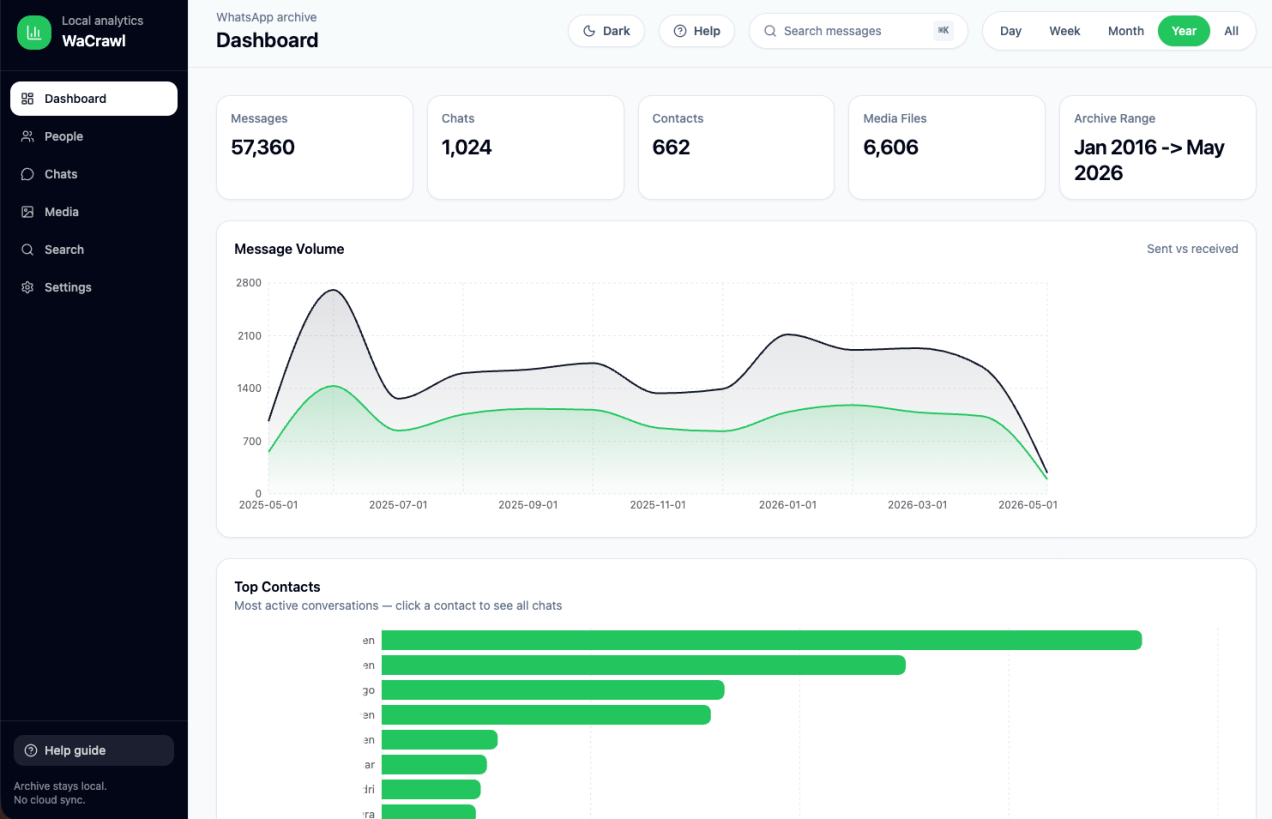
A few months ago I wrote about building a local analytics dashboard for WhatsApp using the amazing WaCrawl project.
If you haven’t read it yet, start here:

Unlock Your WhatsApp Data with a Local Analytics Dashboard

Since then, the project has evolved dramatically.
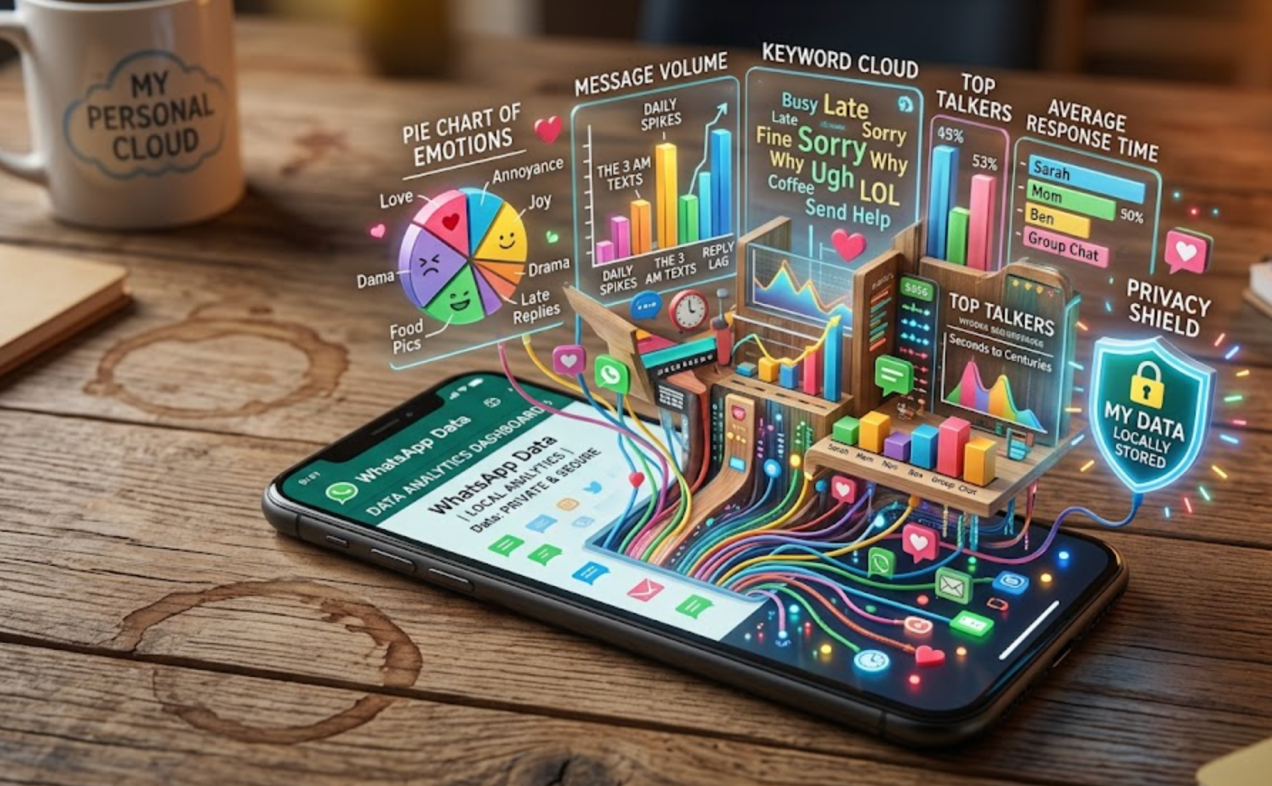
It is no longer just a visualization of your messages—it’s becoming a complete analytics platform for understanding years of conversations while keeping every byte on your own computer.

If you’re the kind of person who has accumulated hundreds of thousands (or millions) of WhatsApp messages, you’ll probably discover things about your communication habits that you never noticed before.

Why Another WhatsApp Analytics Tool?

Most messaging analytics products have one major problem:

They require uploading your conversations to someone else’s servers.
That’s a non-starter for most people.

The dashboard follows one simple rule:
Your messages never leave your machine.

The application reads the local SQLite archive produced by WaCrawl and exposes a read-only API that is only accessible from localhost.

Continue reading
Standard
AI

Unlock WhatsApp Data with Local Analytics Dashboard

Most people think of WhatsApp as “just messaging.”

But after years of conversations, support threads, customer discussions, team coordination, and random life moments… it quietly becomes one of the richest personal datasets you own.

So I built wacrawl-ui — a local analytics dashboard for WhatsApp archives generated by wacrawl.

The idea is simple:

  • Your data stays local
  • No cloud sync
  • No browser extension
  • No scraping APIs
  • No “AI magic” uploading your chats somewhere
Continue reading
Standard
AI

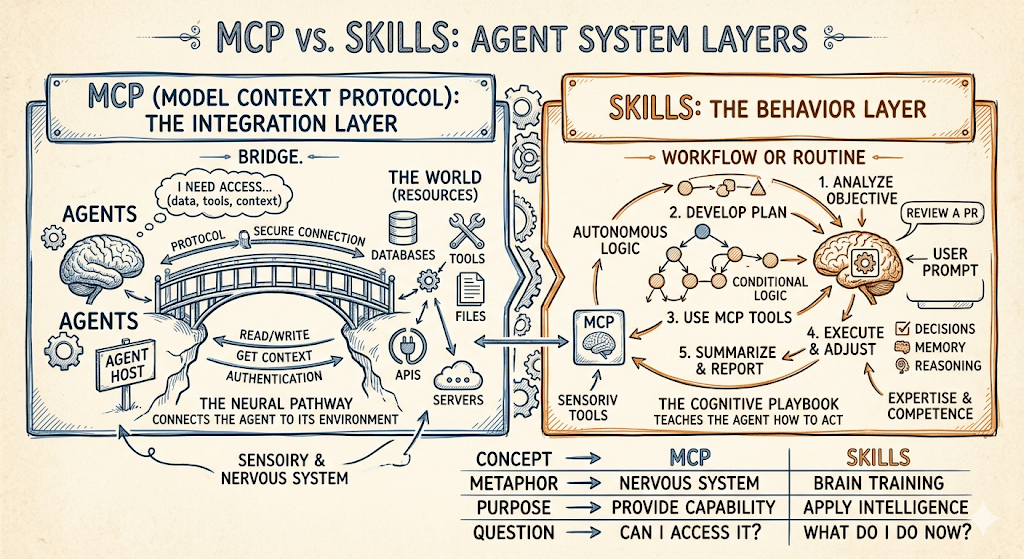
Understanding MCP vs Agent Skills: Key Differences Explained

There’s a lot of confusion right now between MCP (Model Context Protocol) and “Agent Skills.” They’re often mentioned in the same breath, but they solve different problems. If you treat them as interchangeable, you’ll either over-engineer simple workflows or underpower serious integrations.

Here’s the clean way to think about it.

The Core Difference

MCP is about connecting agents to systems.
Skills are about teaching agents how to do things.

That distinction alone gets you 80% of the way.

Integration Model

MCP is a client-server protocol. You stand up an MCP server, expose tools, and now multiple agents can talk to multiple backends through a consistent interface. It’s a hub.

Skills are much simpler: a folder with a SKILL.md file. The agent loads it when triggered and follows the instructions. No protocol, no network layer, no abstraction.

Implication:

  • MCP scales across teams and services
  • Skills scale across use cases and workflows
Continue reading
Standard
Tangled cables with floating social media app icons above an e-waste recycling bin
webdev

How to Clean Up Homebrew (brew) and Maximize macOS Storage

At some point, every dev hits it.
You’re installing something routine—npm install, a Go build, whatever—and macOS throws it in your face:

Disk Full.

You check storage, expecting the usual suspects. Not your videos. Not even Docker (okay, maybe a little).
It’s Homebrew quietly eating your SSD in the background.

Left unchecked, Homebrew turns into a museum of bad decisions:

  • tools you needed once, 14 months ago
  • duplicate runtimes “just in case”
  • dependencies of dependencies of dependencies

Let’s fix it—without nuking your setup.

Continue reading
Standard
AI, Business

Building Continuous AI Agents with OpenClaw and Ollama

Most people are still using AI like it’s 2023:
prompt → response → done.

That’s not where things are going.
The real shift is toward agents that run continuously and do work for you. And one of the most interesting ways to get there today is:

OpenClaw + Ollama

Before diving in, quick grounding.

What OpenClaw and Ollama Actually Are

OpenClaw is an open-source agent framework.
It’s not a chatbot—it’s a system that can:

  • plan tasks
  • call tools (browser, APIs, files)
  • maintain memory
  • run loops without constant input

Think: a programmable worker, not a Q&A interface.

Ollama is the simplest way to run large language models locally.
It handles:

  • downloading models (Llama, Gemma, etc.)
  • running them efficiently on your machine
  • exposing them via a clean API

Think: Docker for LLMs.

Put them together and you get:

A local, autonomous agent system with zero API costs and full control.

Continue reading
Standard
bots, Business, JavaScript

Streamline Engineering Updates with Slack to Notion Bot

There’s been a lot of noise lately about productivity tools and the “perfect” engineering workflow.
Let’s slow down and separate what actually works from what just creates more overhead.

Here’s a boring truth: Slack is incredible for quick, ephemeral communication.
Here’s a less comfortable truth: It is an absolute nightmare as a system of record.

If you lead an engineering team or run a startup, you probably have a #daily-updates or #eod-reports channel.
The theory is sound.

Everyone drops a quick note at the end of the day: what they shipped, what blocked them, what’s next.

But here is what actually happens:

Those updates get posted.
Someone replies with an emoji.
A thread erupts about a weird bug in production.
Someone posts a picture of their dog.

By Friday, when you’re trying to answer a simple question—“What did we actually accomplish this week?”—those reports are buried under a mountain of noise.

You find yourself scrolling endlessly.
It’s exhausting.
And it doesn’t scale. Not to mention that if you will need SOC-2 (and you will 🙂 ) –> you can’t say “we have everything in Slack”

Why not just force everyone into Jira or Linear?

You could.
But engineers hate context-switching just to write a status update.
Slack is where the conversation is happening.
The friction to post there is zero.

The problem isn’t the input. The problem is the storage.

So I (=Gemini+Claude) built a bridge.

Meet the Slack → Notion EOD Sync Bot

I got tired of losing track of momentum, so I wrote a bot that does the tracking for us.

It’s a lightweight NodeJS service that automatically extracts End-of-Day reports from Slack and structures them beautifully in a Notion database.

Continue reading
Standard
life, Sport

Optimize Your Murph Challenge Experience with This Tracker

The Murph Challenge isn’t a workout.
It’s a systems failure conducted at heart-rate redline.

If you’ve ever tried to remember whether you’re on rep 183 or 193 of squats while your lungs are filing a formal complaint, you already know: human memory is not a reliable datastore under load.

So I built a Murph tracker that does exactly one job well—count reps—while I focus on the important things, like not dying.

🎖️ What is Murph (and why people keep doing it)

The Murph Challenge is performed on Memorial Day to honor Lt. Michael P. Murphy, a Navy SEAL killed in Afghanistan in 2005.

It was his favorite workout. Originally named “Body Armor”, which feels accurate in the same way “production incident” feels accurate.

The canonical version:

  • 1 mile run
  • 100 pull-ups
  • 200 push-ups
  • 300 squats
  • 1 mile run

Optional difficulty modifier: wear a 20 lb vest and rethink your life choices.

Continue reading
Standard
Design, webdev

Essential System Design Tips for Startups

You’re launching your first startup… Well, Congrats!

Whether it’s a SaaS invoicing tool, an e-commerce shop for handmade goods, or a new social app, you’ll quickly hit a truth: system design is your blueprint.

Done right, it makes your app boringly reliable. Done wrong, you’ll spend more time firefighting than building features.

This post is based on Sean Goedecke’s excellent piece on system design, reshaped with a founder’s lens: lean, practical, and ready for bootstrapped growth.


Continue reading
Standard
life, Sport

Weather 4 Bike: From Forecasts to Ride Decisions

Why

Most weather apps just tell you the numbers—temperature, wind, UV, etc.—but as cyclists, we need to know what those numbers mean for the ride.

Weather 4 Bike bridges that gap: it translates raw weather forecasts into clear, activity-aware guidance for road, gravel, and MTB. With one glance, you know whether to head out, wait, or change routes.

Continue reading
Standard
cloud, webdev

How to Use ngrok and LocalTunnel: Expose Your Local APIs to the World

Intro

As developers, we often face the challenge of testing our local applications with external services, webhooks, or mobile devices. Whether you’re developing APIs that need to communicate with AWS/GCP/Azure services, testing webhook integrations, or simply want to demo your work from different devices, exposing your localhost to the internet becomes essential.

This guide will walk you through two popular solutions: ngrok and LocalTunnel, showing you how to securely expose your local development server to the world.

What Are Tunneling Services?

Tunneling services create a secure tunnel from a public endpoint to your local machine, allowing external services to reach your development server without complex network configuration or deployment.

Common Use Cases

  • Testing webhooks from third-party services (Stripe, GitHub, etc.) — You can connect your local code directly and debug it more efficiently.
  • Sharing your work-in-progress with clients or team members — Instead of pushing it to some remote server. Useful in all the cases, where you are still ‘not ready’.
  • Testing mobile applications that need to connect to your local API — A must have in almost all cases.
  • Integrating with AWS services that require publicly accessible endpoints
  • Cross-device testing and debugging
Continue reading
Standard