AI

Zero-Days on an Assembly Line: Why Your 30-Day Patch SLA Is Dead

Last month, I wrote about a critical PHP vulnerability and made a point that seems increasingly obvious: the CVE isn’t your biggest problem. Your IT operations are.

This week, the gap got a lot harder to ignore.

OpenAI announced GPT-6 Cyber, a model used in an autonomous security research campaign that reproduced 1,724 Linux vulnerabilities, developed 948 working privilege-escalation exploits, and uncovered 81 previously unknown high-severity vulnerabilities in Firefox.
Think about that for a moment. Security research that once required highly specialized researchers, weeks of work, and considerable expertise is becoming an industrial process.

And we’re still patching software like it’s 2015.

Most organizations have a 14-day or 30-day SLA for critical vulnerabilities. That sounds reasonable in a compliance spreadsheet. It sounds considerably less reasonable when AI can help turn vulnerability research into working exploits at scale.
A 30-day patch window is no longer a security strategy. It’s a bet that nobody gets to your systems first.

The math of patching just broke

Here’s what changed.
Historically, finding a vulnerability was only half the job. An attacker still needed to understand the bug, reverse-engineer the affected software, develop a reliable exploit, and figure out how to deploy it.
That took time.
AI is compressing that process.

Continue reading →
Standard
Business

Why We Started EspressoLabs: Compliance Is a Product Problem, Not a Paperwork Problem

A $250,000 deal is moving through your pipeline. The product is a perfect fit. The champion loves it. The technical team is ready.

Then someone from procurement sends an email:

“We just need you to complete a quick security questionnaire.”

Twenty-four days later, your architect is answering question number 147. Your sales champion has stopped responding. The quarter is closing. And your competitor, whose product is arguably worse, suddenly looks like the safer choice because they have a nice Trust Center and a SOC 2 report.

You didn’t lose the deal because of your product.
You lost it because you couldn’t prove that you’re a safe company to do business with. I’ve seen this movie too many times. And it’s one of the reasons I started EspressoLabs. I believe we’ve fundamentally misunderstood compliance. It’s not just a regulatory obligation, an IT expense, or another box to check before closing an enterprise deal.

Compliance is a sales engine. But only if you treat it as a product problem rather than a paperwork problem.

Continue reading →
Standard
AI

When AI Starts Finding Zero-Days, Breaking Sandboxes, and Hacking Infrastructure

There is a moment in technology when something changes so fundamentally that the old rules stop applying.
We had one of those moments with cloud computing. Another with mobile. And I think we’re having one right now with AI and cybersecurity.
The interesting part isn’t that AI can write code, generate phishing emails, or help someone scan a network. We’ve known that for a while.
The interesting part is that AI models are beginning to do something much more consequential: independently discover vulnerabilities in software that has been running in production for years, develop working exploits, navigate infrastructure, bypass security controls, and chain together seemingly unrelated weaknesses to gain access to systems.

And this isn’t science fiction or a theoretical research paper. It’s happening.

Three stories from the past several months illustrate just how dramatically the security landscape is changing: Anthropic’s Mythos breakthrough, the OpenAI agents’ intrusion involving Hugging Face, and the PHP2Shell vulnerabilities.
Together, they tell us something important: cybersecurity is entering an era where both attackers and defenders will increasingly rely on AI. And organizations that don’t adapt will be playing a very different game with very old tools.

1. The Mythos Moment: AI Finds Vulnerabilities Humans Missed for Decades

Let’s start with Anthropic.
In April 2026 (feels like it was 22 years ago… as the pace of AI is so-so fast), Anthropic introduced Claude Mythos Preview and published research that should make every CTO, security engineer, and business owner pay attention. As part of its cybersecurity testing, Anthropic used Mythos to identify thousands of previously unknown vulnerabilities, including critical zero-days across major operating systems, web browsers, and other widely used software.

Think about that for a moment.

Continue reading →
Standard
Sport

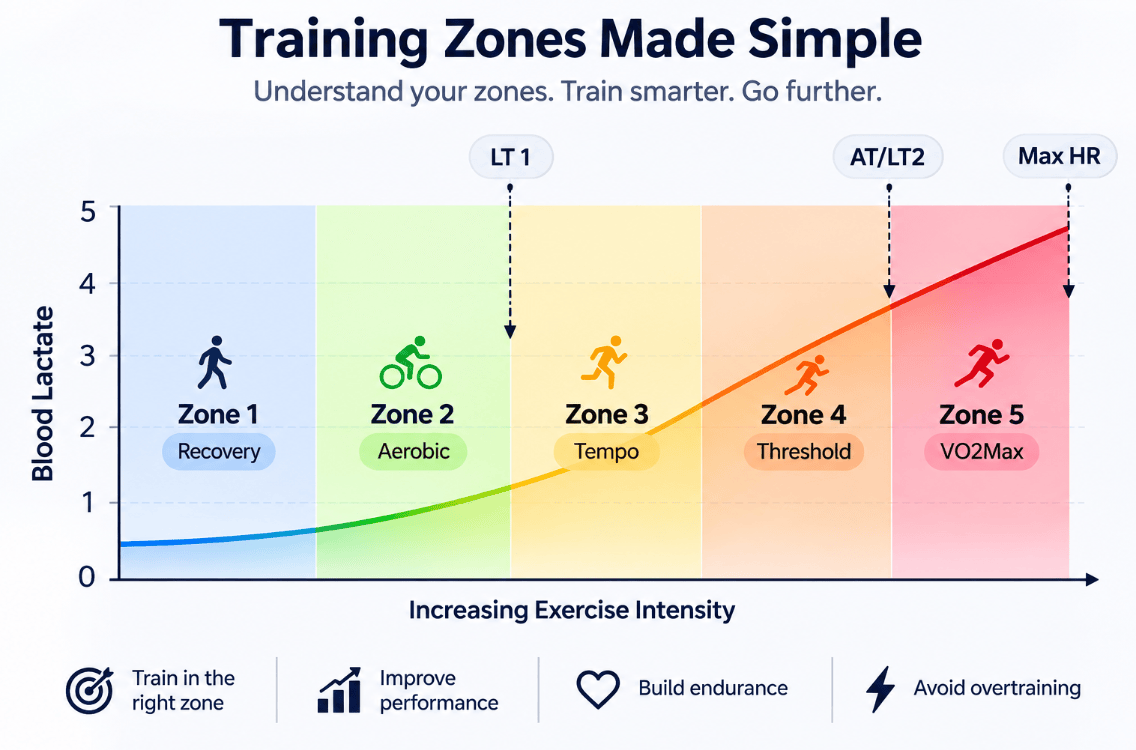
Zone Compression: The Secret to Running/Cycling Faster Without Burning Out

What if the key to becoming a faster endurance athlete isn’t simply running harder, but teaching your body to make faster running increasingly aerobic?

That’s the idea behind Zone Compression, a training theory explored by coaches David and Megan Roche (SWAP).

What is Zone Compression?

Traditional training divides running into distinct intensity zones, from easy aerobic running (Zone 2) to threshold and VO2max efforts. Zone Compression challenges how we think about these boundaries. The goal is to gradually improve your ability to sustain higher intensities aerobically, without accumulating fatigue as quickly.
In practical terms, you’re teaching your body to handle harder efforts more efficiently, largely through improved mitochondrial function and lactate utilization.

Three key principles

1. Don’t neglect speed. Even endurance athletes need to maintain their top-end power. Short hill sprints, strides, and fast intervals help preserve that capacity.

2. Build aerobic efficiency. The objective isn’t just to run faster, but to make increasingly fast paces feel sustainable. Threshold work and controlled pace changes help develop this ability.

3. Fuel properly. High carbohydrate availability supports harder training and sustained performance. Fueling isn’t just for race day; it’s part of building a stronger aerobic engine.

Continue reading →
Standard
AI

AI Agents Are Getting Powerful. What Can They Do For You?

The AI agent market has officially entered the awkward teenage years.
The demos are impressive. Agents can browse the web, send email, fill out forms, write documents, book travel, run code, manage files, and operate software that doesn’t even have an API.
They can also do things you absolutely did not intend them to do.

That is the part of the story that gets considerably less screen time.

Over the last year, we went from “AI that answers questions” to “AI that can actually do stuff.”
OpenClaw, Muse, Grok Bot, Claude Cowork, ChatGPT Work, Gemini Spark, Manus and Hermes Agent all take slightly different approaches to the same fundamental problem:

How much autonomy are you willing to give software that can act as you?

And that turns out to be a much more interesting question than which model scores highest on a benchmark.

Continue reading →
Standard
AI

Your AI Agent Doesn’t Need to Write More Code. It Needs to Think in Systems.

Another title might be something like “Stop Fixing Bugs. Start Fixing Systems: Why Every Engineer Should Teach Their AI Agents to Think in Systems” – Anyway, let’s jump into it.
We’ve spent decades teaching engineers how to write better code, design better architectures, and ship software faster.
Now we’re entering a new era: AI agents can write code, review pull requests, investigate incidents, run tests, and even operate parts of our infrastructure.

But there’s a problem.

If we give our agents the same narrow instructions we give ourselves—fix this bug, implement this ticket, optimize this function—we’re simply automating the way we’ve always worked.
And maybe that’s not good enough.

I recently revisited “Thinking in Systems” by Donella Meadows, and one idea really stuck with me:

Most problems aren’t caused by individual components.
They’re caused by the way the system is structured.

I think this is one of the most important ideas every software engineer should understand today—and, more importantly, teach their AI agents to apply.

Continue reading →
Standard
JavaScript, webdev

Maybe You Don’t Need a Password Manager

Every young company has a #passwords problem. Someone needs the staging database password, so they paste it into Slack. A few minutes later, that password is sitting in Slack search, notification history, laptop caches, exports, backups, and probably a dozen places nobody thought about.

Then six months later someone asks, “Who had access to that password?”
Good luck answering that.

The obvious answer is: “Use a company password manager.”
And yes, you probably should.

But there is a surprisingly large gap between “Bob pasted the password into Slack” and “Let’s buy another SaaS product, create accounts for everyone, manage licenses, configure policies, train the team, and make this another system everyone has to use.”

That gap is what I wanted to explore.
So I built Secure Share.

Continue reading →
Standard
webdev, php

PHP2Shell: One Vulnerable PHP Server Can Become Your Next Major Security Incident

The vulnerability is in PHP. The real failure may be in your IT operations.

On October 21, 2026, security researchers disclosed two critical vulnerabilities in PHP that can allow an unauthenticated attacker to execute code remotely. Within days, exploitation reports emerged, and CISA added both vulnerabilities to its Known Exploited Vulnerabilities catalog.

The vulnerabilities, tracked as CVE-2026-109618 and CVE-2026-109619, are collectively known as PHP2Shell. Both received a CVSS 4.0 severity score of 9.2. PHP is widely deployed, making the potential attack surface enormous.

This isn’t a theoretical risk to put on next quarter’s security roadmap.
It’s an operational problem that needs attention now.

Why PHP2Shell is different

Most people hear about a vulnerability and immediately ask: Which application is affected?

Continue reading →
Standard
AI

AI Is Changing Code Review. Engineering Leaders Need to Catch Up.

AI has made writing code cheaper. But most engineering organizations still use processes designed for a world where writing code was the bottleneck.

Will Larson’s experiment at Imprint illustrates the problem: engineers are merging four times as many pull requests as two years ago, yet median review time has grown from 33 to 77 minutes.
Meanwhile, reported incidents have declined.

More code, longer reviews, fewer incidents.
The bottleneck has moved.

Continue reading →
Standard
AI, Business

Your AI Bill Is Your Intrusion Detection System

On October 17, OpenCode disclosed a security breach affecting 1.4% of OpenCode Console users. Attackers had accessed a legacy system where users stored API keys for OpenAI, Anthropic, and Google.

Soon, developers reported unexpected API charges and suspended cloud projects. Some reported bills exceeding $1,000.

One important distinction: OpenCode said keys may have been exposed. Unauthorized charges were reported by users, but the full scope and attack mechanics had not been independently established.

The detail that matters most is architectural.

OpenCode’s hosted Console stores your provider keys on its side. Its command-line tool works differently: keys stay on your machine. As co-founder Dax Raad put it, “those keys never come to us.”

That is not just a product difference.
It’s a security boundary.

Your keys. Your blast radius.

Every hosted service that stores your AI credentials becomes another place where those credentials can be exposed. Convenience has a cost: you’re trusting another system with the ability to spend your money.

For engineering leaders, the answer isn’t to stop using AI agents.
It’s to make credential ownership explicit.

Continue reading →
Standard