
What if the key to becoming a faster endurance athlete isn’t simply running harder, but teaching your body to make faster running increasingly aerobic?
That’s the idea behind Zone Compression, a training theory explored by coaches David and Megan Roche (SWAP).
What is Zone Compression?
Traditional training divides running into distinct intensity zones, from easy aerobic running (Zone 2) to threshold and VO2max efforts. Zone Compression challenges how we think about these boundaries. The goal is to gradually improve your ability to sustain higher intensities aerobically, without accumulating fatigue as quickly.
In practical terms, you’re teaching your body to handle harder efforts more efficiently, largely through improved mitochondrial function and lactate utilization.
Three key principles
1. Don’t neglect speed. Even endurance athletes need to maintain their top-end power. Short hill sprints, strides, and fast intervals help preserve that capacity.
2. Build aerobic efficiency. The objective isn’t just to run faster, but to make increasingly fast paces feel sustainable. Threshold work and controlled pace changes help develop this ability.
3. Fuel properly. High carbohydrate availability supports harder training and sustained performance. Fueling isn’t just for race day; it’s part of building a stronger aerobic engine.
Understanding the training zones
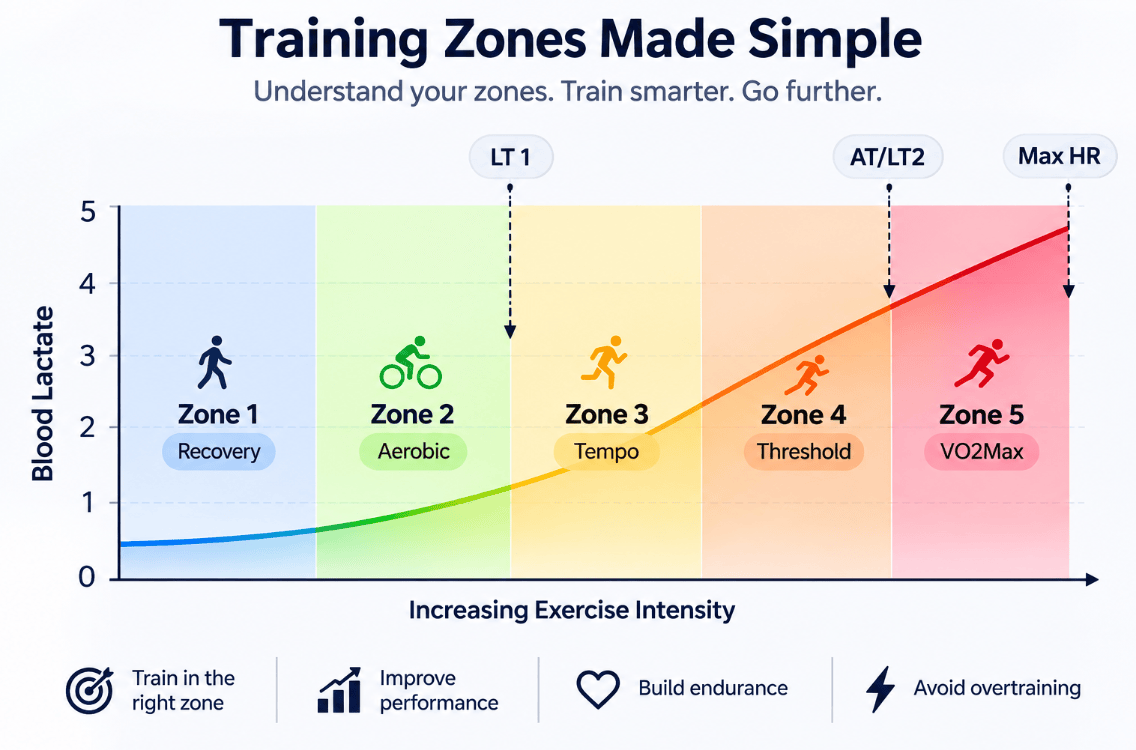
Training zones describe how hard your body is working. They are generally defined by heart rate, lactate levels, or ventilatory thresholds. Different coaching systems use 3, 5, or 7 zones, but a useful simplified model is:
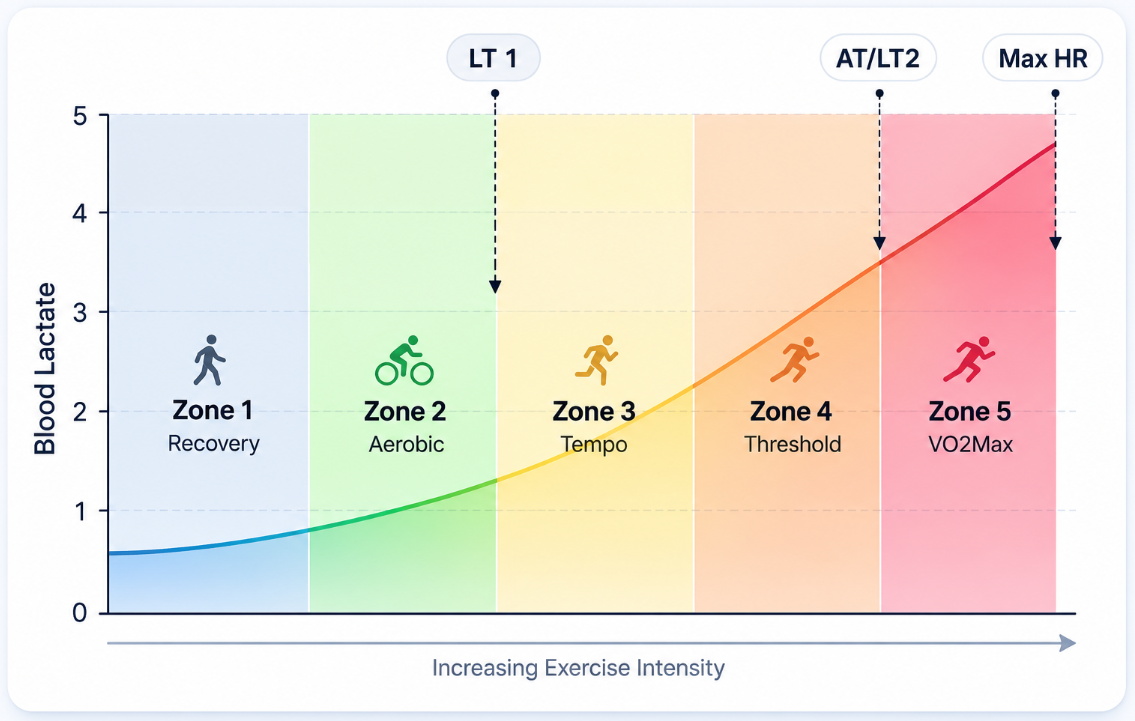
- Zone 1 – Recovery – Very easy – Low effort, promotes recovery
- Zone 2 – Aerobic – Easy, conversational – Builds aerobic endurance; generally below the first lactate threshold (LT1)
- Zone 3 – Tempo – Moderate to comfortably hard – Between LT1 and LT2; increasing metabolic stress
- Zone 4 – Threshold – Hard, controlled – Around the second lactate threshold (LT2); sustainable for a limited period
- Zone 5 – VO₂max – Very hard – Near maximum oxygen consumption; typically interval-based efforts
- Zone 6 – Anaerobic – Near maximal – Short, intense efforts relying heavily on anaerobic energy systems
Two important thresholds
* LT2 (Second Lactate Threshold): A higher intensity where lactate accumulation becomes substantially harder to manage. Sustaining this effort becomes increasingly difficult.
* LT1 (First Lactate Threshold): The point where blood lactate begins to rise consistently above baseline. Below it, you can generally maintain an effort for a long time.
One particularly interesting approach is combining fast efforts with sustained aerobic running:
- 5 × 3-minute hill intervals.
- Follow immediately with 15 minutes of controlled threshold or steady running.
- Recover appropriately.
Another option is alternating half a mile at 10K pace with half a mile at marathon pace, using relatively fast recovery efforts.
The idea is to challenge your body to keep working efficiently even after harder efforts.
Why it matters
Whether you’re training for a 5K, marathon, or ultramarathon, the underlying objective is similar: increase the intensity you can sustain without falling apart.
Zone Compression isn’t yet a scientifically established training system, and some of its proposed mechanisms need further validation. But it offers an interesting way to think about endurance development.
The real goal isn’t simply to become faster.
It’s to make faster running increasingly aerobic.
That’s a concept worth exploring in your next training block.
Be strong.
— If you wish the full story – please check Zone Compression theory discussed by David and Megan Roche (SWAP).
Discover more from Ido Green
Subscribe to get the latest posts sent to your email.

