Business

Understanding the CMMC Pause: Key Changes and Action Steps

On July 13, 2026, the Department of War announced the immediate suspension of CMMC Phase II requirements. The move was memorialized in a memo dated July 10, 2026, signed by DoW Chief Information Officer Kirsten Davies. Those requirements had been scheduled to take effect on November 10, 2026, and would have pushed many contracts handling Controlled Unclassified Information (CUI) into mandatory third-party C3PAO assessments.

The stated goal is straightforward: reduce compliance barriers for small, medium, and non-traditional businesses so the Defense Industrial Base can expand faster under the Department’s current acquisition priorities.
A 60-day CMMC Reform Task Force review is now underway, including a public Request for Information seeking industry input on cost drivers and administrative burden. Phase I self-assessment requirements remain firmly in place.

This is not a free pass.
It’s a pause on one layer of bureaucracy — not a suspension of the underlying security obligations.

What Actually Changed (and What Didn’t)

Suspended

  • The November 2026 transition to Phase II — third-party Level 2 assessments as a condition of award in many cases.
  • Pending and future CMMC implementation milestones (including Phase III and IV) that would have required C3PAO or DIBCAC assessments.
  • During the review period, contracting officers are limited to requiring only Level 1 (Self) or Level 2 (Self) assessments in new procurements.
  • Existing contracts that already contain Phase II language will have that language removed by modification, either before the next option period or at the next scheduled administrative update.

Still fully in force

  • Phase I self-assessments and annual affirmations in SPRS.
  • DFARS 252.204-7012 obligations to protect covered defense information and implement NIST SP 800-171 controls.
  • Contractual cybersecurity requirements that primes flow down to subcontractors.
  • The Department of Justice’s Civil Cyber-Fraud Initiative, which continues to treat inaccurate self-assessments and false claims seriously.

The official release is worth reading in full: Forging the Arsenal of Freedom: Department of War Suspends CMMC Phase II Requirements. The SBA has also publicly backed the move, arguing the prior framework was pushing small firms out of the defense supply chain.

In short: the certification theater got paused. The requirement to actually protect the data did not.

Continue reading →


Standard
AI, Business

Building a CMMC Readiness Calculator That People Can Actually Finish

Most compliance tools look great in screenshots.

Far fewer are useful on a random Tuesday afternoon when someone in operations, IT, or leadership is trying to answer a simple question:

“How ready are we, really?”

That’s the problem we set out to solve.

Not certification.
Not auditing.
Not replacing consultants.

Just helping defense contractors get a realistic picture of their CMMC readiness before investing weeks of meetings, spreadsheets, and assessment calls.

The result is a simple CMMC Readiness Calculator that turns a short questionnaire into:

  • an estimated readiness score
  • an estimated SPRS score
  • a count of missing or partially implemented controls
  • a three-year compliance cost projection
  • a comparison between traditional and managed compliance approaches

Nothing magical.
Just useful.

Continue reading →
Standard
Futuristic cockpit with holographic compliance and cybersecurity monitoring dashboard
AI, Business

CMMC Certification Cost: How AI-Native Compliance Can Cut Expenses by over 70%

If you’re pursuing CMMC certification, one of the first questions you’ll ask is:

How much does CMMC certification cost?

The answer depends on your current security posture, the size of your organization, and how you approach compliance. For many small and mid-sized businesses, the total cost of achieving and maintaining CMMC Level 2 compliance can range from tens of thousands to hundreds of thousands of dollars.

The surprising part?

The audit itself is rarely the biggest expense.

Continue reading →
Standard
Modern office building with digital graphic illustrating secure data, verified access, and network integrity
AI, Business

Bridging the Cybersecurity Gap for SMBs

I recently joined the MSP 1337 podcast with Chris Johnson to talk about something I’ve been thinking about for years:

Small and midsize businesses are being asked to operate with enterprise-level security expectations — without enterprise-level resources.

That gap is becoming impossible to ignore.
And AI is accelerating both sides of the problem.

Attackers are moving faster.
Infrastructure is becoming noisier.
Compliance requirements are multiplying.
Meanwhile, SMBs and MSPs are still expected to somehow manage everything with limited staff, fragmented tools, and endless alerts.

That model is cracking.

Btw, you can listen to it here:
– Apple Podcasts
– Spotify

Continue reading →
Standard
Animated coffee cup with a spoon glowing magical shield against dark fiery monsters
AI, Business

SMB Cybersecurity Is Broken — Here’s What We’re Doing About It

SMB cybersecurity is a mess. Yes – It’s 2026 and it’s broken. Big time.

Too many tools.
Too many dashboards.
Too many alerts that nobody has time—or context—to act on.

And the result?
A false sense of security.

You can have RMM, MDM, EDR, SIEM, compliance tools… and still be exposed. Not because the tools are bad—but because the system is unworkable for the people actually running it.

Most small and mid-sized businesses don’t have a SOC.
They don’t have a dedicated security team.
They don’t have time to interpret 300 alerts a day.

What they have is:

  • An overstretched IT person (or MSP or the owner that is busy with 127 other things that are all urgent)
  • A growing attack surface
  • And a stack of tools that don’t talk to each other

That’s the real gap.

A Quick Look

We recently shared a glimpse of what we’re building here:

Continue reading →
Standard
AI, Business

Compliance Is Not a Checkbox – It’s a System

Let’s be honest.
Compliance today is broken for SMBs.
It’s fragmented.
Expensive.
Manual.
And worst of all—reactive.

You buy a few tools.
Hire a consultant.
Fill out some spreadsheets.
Panic before the audit.
Repeat next year.

Meanwhile, the reality has changed:

  • SOC 2 is table stakes
  • CMMC is blocking revenue
  • HIPAA fines are brutal
  • ISO 27001 is becoming expected

And one unsecured laptop can kill a deal.

The Core Problem

Most companies treat compliance like documentation.
It’s not.
It’s continuous enforcement of controls across your entire environment.

That means:

  • Every device encrypted
  • Every patch applied
  • Every user monitored
  • Every control provable—on demand

You can’t fake that with PDFs.

Continue reading →
Standard
AI, bots, Business

Agentic AI for SMB Cybersecurity

Cybersecurity is becoming impossible for small companies to manage manually.

At the same time, CMMC compliance is no longer optional for companies working with the Department of DefenseWar. Since late 2025, cybersecurity requirements are now embedded directly into DoW contracts, forcing suppliers and subcontractors to prove they can protect sensitive data. (Business Defense)

The problem?

Most SMBs don’t have a security operations center.
They barely have a security engineer.

Meanwhile attackers are moving faster every year.

The good news: AI agents are starting to change the equation.

We’re entering the era of agentic cybersecurity—where autonomous AI systems monitor infrastructure, collect compliance evidence, and respond to threats continuously.

If implemented correctly, this can give small teams enterprise-level security operations with almost no additional headcount.

This post explains:

  1. What “agentic AI” actually means for cybersecurity (and why Claude won’t give it to you with some ‘vibe’)
  2. How it helps with CMMC compliance and real-time threat monitoring
  3. The risks you must design around
  4. A simple architecture you can build today
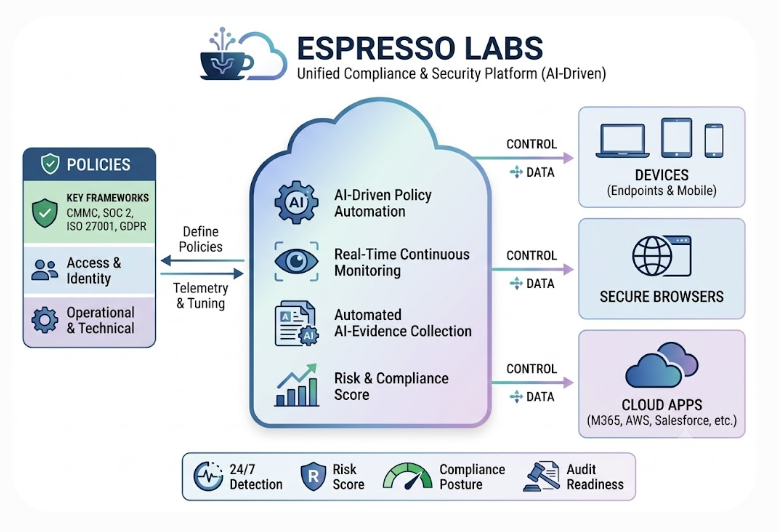
  5. How platforms like EspressoLabs (with the Barista AI) fit into this shift
Continue reading →
Standard
Business

Why Manufacturing Companies Are Switching to Espresso Labs — And Not Going Back

Manufacturing is no longer “just” physical.

Your CNC machine talks to a Windows box.
That Windows box talks to email.
Email talks to the internet.
And the internet talks back.

Ransomware targeting manufacturing jumped 61% heading into 2026. That’s not abstract.
That’s a shift supervisor staring at frozen screens at 4:12am while production bleeds cash by the minute.

If you run a mid-market plant, here’s the uncomfortable truth: you probably don’t have a 24/7 security team. You probably have one IT person juggling printers, patches, Wi-Fi complaints, and compliance spreadsheets. And you definitely don’t have time for a cyber incident.

That’s why manufacturers are moving to EspressoLabs.

Not because it’s trendy.
Because it works.

Continue reading →
Standard
Business

CMMC Compliance: Why It Matters for Your Business

It’s not easy early in the morning… but let’s talk about CMMC.

If you work with the Department of Defense—or want to—you’ve probably had one of these moments:

  • “Wait, we need how many controls?”
  • “Is this just NIST 800-171 with extra paperwork?”
  • “Can’t we just say we’re secure?”

Short answer: no.
Long answer: definitely no.

What CMMC Really Is (Without the Buzzwords)

CMMC (Cybersecurity Maturity Model Certification) is the DoD’s way of saying:

“If you want access to our contracts, prove you can protect Controlled Unclassified Information (CUI).”

It formalizes what many companies should have been doing already:

  • Enforcing strong access controls
  • Logging and monitoring activity
  • Managing vulnerabilities
  • Hardening endpoints
  • Applying real security policies (not just a PDF in SharePoint)

In other words: operational cybersecurity, not theoretical cybersecurity.

Continue reading →
Standard