AI, Business

Simple Steps to Protect Your Business from Ransomware

There’s a new ransomware playbook.
It doesn’t try to evade your security tools.
It just kills them.

Attackers are using BYOVD (Bring Your Own Vulnerable Driver):

  • They load a legitimate, signed Windows driver
  • Exploit it to get kernel-level access
  • Then shut down your EDR/antivirus like any normal process

No alerts. No resistance. Just silence.

From there, encryption is trivial.

This is already being packaged into single payloads:
break in → disable security → encrypt
All in one move.

Execution time: minutes, not days.

The uncomfortable truth:

“We have EDR” is no longer a security strategy.

Attackers don’t need to bypass your defenses anymore.
They just turn them off.

What actually matters now for SMBs

Continue reading
Standard
Business

Why Manufacturing Companies Are Switching to Espresso Labs — And Not Going Back

Manufacturing is no longer “just” physical.

Your CNC machine talks to a Windows box.
That Windows box talks to email.
Email talks to the internet.
And the internet talks back.

Ransomware targeting manufacturing jumped 61% heading into 2026. That’s not abstract.
That’s a shift supervisor staring at frozen screens at 4:12am while production bleeds cash by the minute.

If you run a mid-market plant, here’s the uncomfortable truth: you probably don’t have a 24/7 security team. You probably have one IT person juggling printers, patches, Wi-Fi complaints, and compliance spreadsheets. And you definitely don’t have time for a cyber incident.

That’s why manufacturers are moving to EspressoLabs.

Not because it’s trendy.
Because it works.

Continue reading
Standard
Business, webdev

Stay Ahead of Cyber Threats with CISA Advisory Monitor

Here’s a boring truth:
Cybersecurity and Infrastructure Security Agency publishes critical cybersecurity advisories.

Here’s a less comfortable truth:
Most teams never check them.

CISA maintains the Known Exploited Vulnerabilities (KEV) catalog. These are not “theoretical risk under certain lab conditions” bugs. These are vulnerabilities attackers are actively exploiting in the wild, right now, against real systems.

When something lands in KEV, it’s not a polite suggestion. It’s a flare in the sky that says: patch this, or prepare for visitors.

And yet—no one wakes up thinking, “Before coffee, let me refresh a federal website.”

We’re building product.
We’re shipping features.
We’re arguing in Slack.
We’re trying to remember where that one Terraform variable is defined.

So I built a bot that does the refreshing for us.

Continue reading
Standard
Business

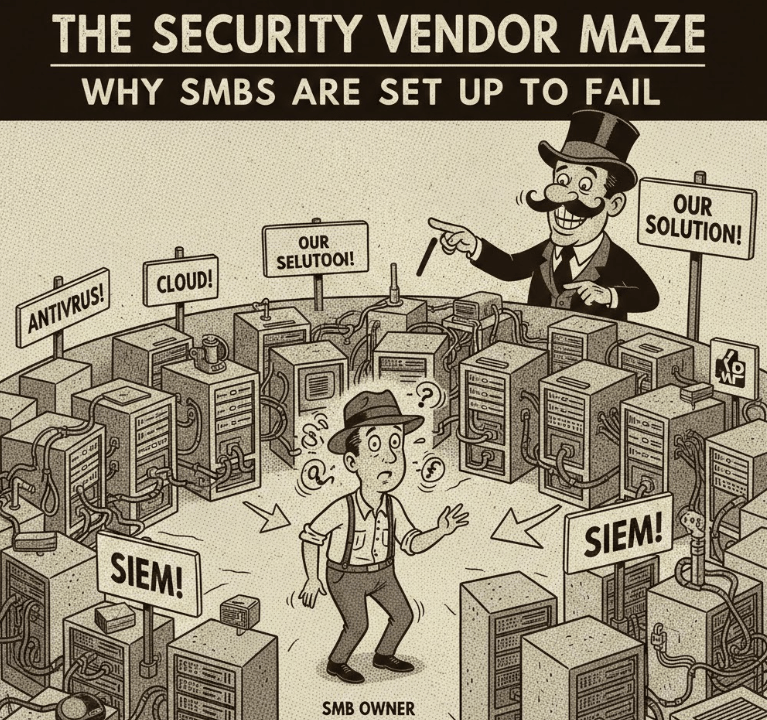
The Security Vendor Maze: Why SMBs Are Set Up to Fail

A founder asked me recently a simple question:

“How many security tools do we actually need to be protected like an enterprise?”

I gave him the honest answer.

Six to ten different platforms. Minimum.

There was a pause.
Then his face dropped.

Because in that moment, he realized what many SMB founders eventually discover the hard way: modern cybersecurity was never designed for companies like theirs.

Continue reading
Standard
cloud, webdev

5 Essential Security Moves Every Startup & SMB Must Make to Prevent Cyber Attacks

If you’re working at a startup or SMB, you might think “we’re too small to be targeted.” You might believe that cyber attackers only go after Fortune 500 companies with deep pockets and valuable data worth millions.

That assumption could destroy your business.

Here’s the uncomfortable truth: attackers don’t discriminate by company size.
They discriminate by vulnerability.
And right now, small and medium-sized businesses represent the softest, most lucrative targets in the entire threat landscape.

Here are the top 5 things you should do.
Right now.

Continue reading
Standard
Business

Securing Your (NodeJS) Backend: A Comprehensive Guide to Preventing Common Attacks

Web security is a critical concern for any backend developer. If you’re building applications using Node.js and Express, it’s essential to safeguard your backend against common security threats such as SQL injections, cross-site scripting (XSS), cross-site request forgery (CSRF), and other vulnerabilities. This comprehensive guide explores these attacks in depth and demonstrates best practices to prevent them with practical coding examples.

Continue reading
Standard
Business

How to Set Up Nginx on Ubuntu with Let’s Encrypt SSL and Port Forwarding

Introduction

Setting up Nginx on Ubuntu (18+) with Let’s Encrypt SSL ensures that your website or application is secure and accessible over HTTPS, providing a safe browsing experience for your users. This process not only includes the installation of the Nginx web server but also entails configuring the server to handle SSL certificates issued by Let’s Encrypt, enabling automatic renewal of these certificates to maintain uninterrupted security. By following best practices for security and performance, you can optimize your server’s settings to ensure fast loading times and reliable uptime, which are crucial for retaining visitors and improving search engine rankings. Additionally, implementing SSL helps to build trust with your audience, as it demonstrates a commitment to protecting their data and enhancing their online safety.

In this guide, we will:

  • Install and configure Nginx.
  • Set up port forwarding for your Node.js application.
  • Obtain a free SSL certificate from Let’s Encrypt.
  • Ensure proper firewall and AWS security group settings.
  • Troubleshoot common issues.

Let’s get into it…

Continue reading
Standard
Espresso at sunrise
Chrome, cloud, webdev

Personal Cyber Security

In today’s digital world, it’s more important than ever to ensure that your personal cyber security is up to date. With the ever-growing number of threats on the internet, it’s essential to take the necessary steps to protect yourself and your data.

The first step in protecting yourself is to be aware of the threats that exist. The second step is to use the right tools to protect yourself. There are many different types of cyber threats, such as malware, phishing, and ransomware.

Continue reading
Standard
cloud, JavaScript

Integrate JFrog Xray with Slack

The need to protect your software and to be updated about vulnerabilities is getting stronger. JFrog Xray is unique in its capabilities to perform analysis of all the binaries you are consuming in your project. It works with Artifactory to perform a deep analysis of binary components at any stage of the application lifecycle. Xray provides great visibility into issues lurking in components anywhere in your organization and there are many cases where you wish to get notified on a security violation (or a license breach) directly to Slack.

Getting Started

We will use Xray’s Webhooks to define our server’s and base on the policies/rules our Webhook will be notified with the alerts about violations (security or licenses).

Continue reading
Standard
cloud, JavaScript

Export Violations From JFrog Xray to CSV

The trend of #DevSecOps is growing fast and it is no longer just part of your security team. More and more organizations wish to integrate their security team in all the phases of development and operations. To achieve it, there are cases where you need to export data from JFrog Xray (in our case to a CSV format) so you can ingest it to your current logging/monitoring system. 

What is Xray?

In a nutshell, JFrog Xray works with JFrog Artifactory to perform a deep analysis of binary components at any stage of the application lifecycle. It provides full transparency that leads to more trust in your software. 

By scanning binary components and their metadata, recursively going through dependencies at any level (think on the layers you have in any Docker container), JFrog Xray provides great visibility into issues lurking in components anywhere in your organization.

Xray API

One of the best parts is that JFrog Xray is also fully automated through a rich REST API. We will use it to create this Exporter. Please feel free to clone/fork the code below and use it, but remember you might need to add pagination and a watchdog for a real system.

Continue reading
Standard