AI, bots

Leveraging OpenClaw as a Web Developer

This post is a sort of TL;DR about OpenClaw –> What it is, why it matters, and how to integrate it into real workflows

OpenClaw is an open-source AI agent framework that enables you to build conversational and automated systems running on your own infrastructure. Unlike typical “chatbot SDKs,” OpenClaw turns large language models into agents that do real work — handling messages, executing workflows, and integrating with tools and APIs.

For web developers, this opens up a new category of integrations: intelligent assistants embedded into your app, autonomous workflows triggered via REST or webhooks, and programmable bots that connect multiple systems.

“with great power comes great responsibility”

What OpenClaw Actually Is

At its core, OpenClaw consists of these components:

  • Agent Core – orchestrates conversation state and skill invocation.
  • Channels – adapters that connect your agent to messaging platforms (Telegram, WhatsApp, Slack, SMS, browser UIs, REST endpoints).
  • Skill Engine – modular plugins that define actionable logic (e.g. work in your browser with your permissions, read email, fetch data, run a workflow).
  • Sandbox – a safe execution environment for custom code. Start with it and move slowly to allow it more permissions (OpenClaw)

Importantly for developers: OpenClaw is model-agnostic — you choose the LLM provider (OpenAI, Claude, or self-hosted models). It’s also fully open source (MIT), so you can extend and embed it in your deployments without vendor lock-in.

Continue reading
Standard
Business

Decoding the VC Perspective: Navigating Startup Evaluation Memo

A VC memo is a crucial tool for venture capitalists to evaluate startups. It allows to:

  • Document the thinking: The memo forces the VC to think critically about the startup and its potential. This can help them identify potential risks or challenges and make a more informed decision about whether or not to invest.
  • Communicate with their partners: The memo can communicate the VC’s thoughts on the startup to their partners. This helps build consensus within the VC firm and ensures everyone is on the same page about the investment.
  • Track their investments: The memo can track the VC’s investments over time. This can help them assess their portfolio companies’ performance and make adjustments to their investment strategy as needed. It also helps to debrief the decisions in retrospect.
Continue reading
Standard
Business

Overcoming Limiting Factors: Essential #StartupTips for Success

In reality, we see many examples that too much capital makes your startup unfocused, and it’s a curse, not a blessing. Getting funds at the beginning puts you in the wrong position of ‘spending’ money and not earning it. Minimizing it as much as possible is a smart move that helps build a healthy business. One that is making money and spending only some of it. It sounds too basic, but you will be surprised how many founders forget it after raising the first round. You wish to start lean and mean and keep it as long as possible.

Limited capital makes companies focused.

This is important when you wish to build a business and make it profitable in a limited time.

The main limiting factors for startups:

  1. The management team – Can the founders and other leaders make the right decisions and drive execution that is focused and moving the needle to customers?
  2. Focus – Focusing on what to do and, more importantly, what not to do is critical.
  3. Part of that is keeping to play to your strength, not responding to others in the market, and failing to play their game. You can go deeper on the topic in Malcolm Gladwell’s book: “David and Goliath: Underdogs, Misfits, and the Art of Battling Giants” in a nutshell, you (as David) want to move the battle to your expertise so the odds to win will be in your favor.
  4. Time – You got funding, and it’s buying you time to execute. If you can’t reach the milestone you put to yourself, it might lead to a path you wish to avoid (e.g., more rounds and no profitability).

As Henry Ford said:

“If you think you can do it or think you can’t do it – you are probably right.”

It’s always easy to come up with excuses and ‘reasons’ for why: more of X and more of Y could have been helpful, but if you are resourceful and got grit, you can win.

Knowledge, in this case, is half the solution.

Take ownership, focus like a laser, and good luck!

Standard
Business, life

You Don’t Need Status Meetings

The most valuable and scarce resource is time.

As a young startup you must do your best to use it as efficient as possible because you have limited time to show traction and become a profitable business.

Now, there is no doubt that you need to focus and try to spend most of your time on real work. However, we all did it in the past, we get into a room of 5-10 people and everyone is telling the group what they did.

It’s such a waste of time! Even if each person is talking for 5-10min you got here 50-100min of boring meeting which is equal to a waste of time.

Why not have this updates in a tool that let everyone in the team to see what all the others are working on? Continue reading

Standard
Business

Lean Canvas Basics

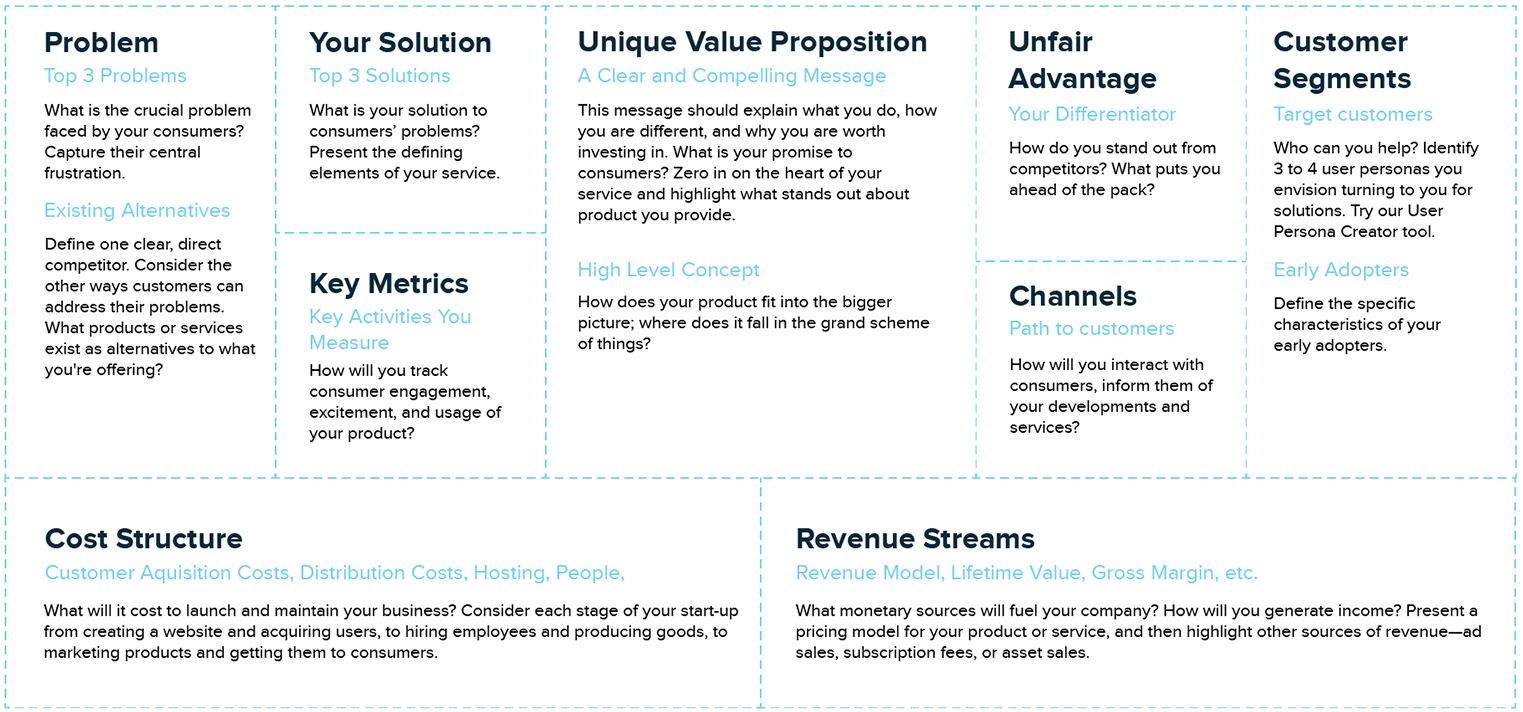
The lean canvas is a tool that helps entrepreneur with forming their idea into a macro plan and later (hopefully) a full function service or product.

You can use something like a good pitch deck to do the same. The core in these tools is to help you articulate what are you going to do and how you are going to win with it.

Let’s have a look at the page below. You can click on it to see it on a full page. If you wish to work with such a template – scroll down and print the clean one that we got in the bottom of this post.

lean canvas

The idea here is to think on our idea and to break it down to the different aspects.

We will fill in short bullet points each section. If you have a co-founder or advisor/mentor to consult with, please do so. It will improve the final result. Also, show the result to many people that you respect. Each might give you a point of view you didn’t think about. Continue reading

Standard
Business

Google Launchpad Accelerator – The 3rd Class

AsiaIn the past ten months, I’ve been busy working with startups in Google’s new program for startups, which we call: “Launchpad Accelerator“.

What?

In this unique program we doing our best to help tech startups build successful business.

How?

We are running this program by working closely with these startups and helping them with the most critical challenges. The analysis and guidance are being done by mentoring sessions. In these sessions we leverage the vast experience of Google’s engineers and other external mentors from top companies and venture capitals in silicon valley. Their value is huge and I’ll update here with specific examples.

When your startup is selected to the program, you get a two weeks at Google Headquarters full of learning and networking opportunities. After that, you have another six months of work with Googlers on your objective and key results. In other words, you get access to Google engineers, resources, and mentors. Which are all aimed to help you do your things better/faster/cheaper and make your startup a success. Continue reading

Standard
Business

Want Great Startups Ideas? Think On Problems!

screen-shot-2016-10-18-at-10-01-53-pmA question I get from time to time is going around “How can you come up with a good idea for a startup?”

It’s the wrong question. In order to get to an answer you do not want to think on a great idea for a startup. Because this won’t lead you in the right path. It might be a cool idea that you and your friends think is wonderful but if it’s not a real problem in the real world, most chances are that people won’t find it useful.

If it’s not useful, you won’t be able to monetize it and build a sustainable business. After all, a startup is a temporary organization in a hunt of scalable, repeatable and profitable business model. So you want to improve your odds in this hunt by identify a common problem.

It’s not only that the better way is to look for problems. It should be a problem that you have.

The very best startup ideas usually contain three aspects:

  1. You (the founder) want to have it. It’s your personal pain point.
  2. You can solve it.
  3. Few others realize that these ideas worth the time and energy to pursue.

Continue reading

Standard
Business

Startup Pitch Deck

In the past 5 years, I meet with hundreds of entrepreneurs and developers that were starting a new company.
In many cases, it was during a pitch or mentoring session.
I learn a lot from these meetings.

One surprising learning was a common intimidation from pitching your startup. If there is one thing that entrepreneurs are really afraid from is this moment of true, when they need to sell.

Let’s not get into the why here but focus on what can reduce this stress.

If you think about it, it’s a way for you to gain trust and show that you can deliver.
No one (with experience) want to see that you got all the answers but investors do want to see that you are thinking on the right issues and you have a plan. It’s true, that “everyone has a plan until they get punched in the face” but it’s still valuable to see such a plan.

Here is the template for a good pitch deck.

The one I will use myself and tell my kid to use.
You can feel free to add slides but please keep in mind that your presentation should not be longer than 15 slides as you want to finish it under 20min and leave room for open conversation. Continue reading

Standard
Business

A New Space For Startups In San Francisco

Today we are opening our new Space for startups in San Francisco.
I can see that you are asking, what?

Well, it is a place to explore the latest technologies and learn how to build successful startups. It a great feeling to build new things and especially when you have the chance to dream about something and than move it forward so it become a reality. I am excited about this place, as it will give us a good option to help more and learn more.

Look below who open it 😉 Continue reading

Standard
Business, Chrome

How To Kanban?

Kan-what?

That is the first thing you hear when someone is hearing about this for the first time. In my last two startups,  I used it and it works quite good for us. Like in Agile / Scrum and all the other methodologies, you need to try and take what works for you. The magic in Kanban is the ability to keep most of the ‘things that works’ and gain productivity. If you like to do daily stand-ups meeting – keep them. If you push new version to production every week – keep it and the list goes on. The power of Kanban is in the ability to improve the communication and to put everyone on the same page, or a board in this case.

The Kanban technique emerged in the late 1940s in Toyota. It was their effort to invent a new approach to manufacturing and engineering. Line-workers displayed colored kanbans (=cards) to notify their downstream co-workers that demand existed for parts and assembly work. The system’s highly visual nature allowed teams to communicate more easily on what work needed to be done and when. It also standardized cues and refined processes, which helped to reduce waste and maximize value.

How to use it in your startup?

Continue reading

Standard