
A $250,000 deal is moving through your pipeline. The product is a perfect fit. The champion loves it. The technical team is ready.
Then someone from procurement sends an email:
“We just need you to complete a quick security questionnaire.”
Twenty-four days later, your architect is answering question number 147. Your sales champion has stopped responding. The quarter is closing. And your competitor, whose product is arguably worse, suddenly looks like the safer choice because they have a nice Trust Center and a SOC 2 report.
You didn’t lose the deal because of your product.
You lost it because you couldn’t prove that you’re a safe company to do business with. I’ve seen this movie too many times. And it’s one of the reasons I started EspressoLabs. I believe we’ve fundamentally misunderstood compliance. It’s not just a regulatory obligation, an IT expense, or another box to check before closing an enterprise deal.
Compliance is a sales engine. But only if you treat it as a product problem rather than a paperwork problem.
The same movie, over and over again
Here’s how it usually goes.
A startup starts getting traction. Enterprise customers show up. Suddenly, someone asks for SOC 2.
Panic.
The company hires consultants, buys a GRC platform, creates 40-page policy documents, collects screenshots, and starts moving evidence into shared folders. A few months later, the audit is complete. Everyone celebrates. The company gets its report.
And then… nothing really changes.
Nine months later, another enterprise customer asks almost exactly the same questions. The team starts collecting evidence again. The CTO is pulled into another security review. Engineers spend days explaining things they already explained to someone else.
It’s almost comical if it weren’t so expensive.
I remember the pattern particularly well in healthcare SaaS. Organizations were going through sales cycles that lasted nine months, with every hospital asking essentially the same questions about encryption, HIPAA, access management, backups, and incident response.
Different questionnaire. Same answers. Different spreadsheet. Same evidence.
Why were companies rebuilding the same answers from scratch every single time?
More importantly, why were engineering teams spending so much time proving that their security processes existed instead of actually improving those processes?
That was the bigger problem.
The audit was never the real problem
Here’s the insight that changed how I think about compliance.
The hard part isn’t passing an audit.
The hard part is building and maintaining the operating system behind it.
Think about what SOC 2 actually requires:
- Evidence collection that happens continuously, not once a year.
- Access reviews that are performed and documented automatically.
- Policies that reflect what the company actually does.
- Security controls that are enforced, not just described in a document.
- Alerts when something breaks, with clear ownership and remediation.
- Answers to customer security questions that are ready before the questions arrive.
Now compare that with what many traditional GRC platforms do. They give you dashboards showing whether controls are compliant. They help you organize evidence and track tasks. Some make the audit process significantly easier.
That’s useful, but it doesn’t solve the underlying problem.
A dashboard telling you that a control failed isn’t the same as fixing the control.
A spreadsheet showing that someone needs to review access isn’t the same as ensuring the review happens. And a policy document saying that access is reviewed quarterly doesn’t mean anyone actually reviewed it.
Here’s the question I keep coming back to:
When a security control fails at 2 a.m., who fixes it, how quickly, and how do you know it actually happened?
That’s an engineering question. It requires automation, integrations, monitoring, remediation, and accountability.
It’s not a paperwork problem.
Why We built EspressoLabs
I’ve spent most of my career building technology products and engineering organizations. From startups to companies like Google, Netflix, and JFrog, I’ve had the opportunity to see how technology teams operate at different scales.
One thing has remained remarkably consistent: companies don’t lack policies. They lack systems that make the right behavior happen automatically.
And security is no exception.
We have incredibly sophisticated technology for building software, deploying infrastructure, monitoring applications, and managing engineering teams. Yet, when it comes to compliance and IT security, many companies are still operating with a surprising amount of manual work.
People collect screenshots. Someone updates a spreadsheet. Another person chases an employee for an access review. An auditor asks for evidence, and suddenly half the company is looking for files.
This isn’t a lack of effort. It’s a lack of engineering.
When we started EspressoLabs, we wanted to approach the problem differently. What if we stopped treating compliance as a collection of documents and started treating it as an automated technology system?
What if the platform didn’t just tell you what was wrong, but actually helped implement, enforce, monitor, and fix the controls? What if the same system that keeps your company secure could also prepare your SOC 2 evidence, answer customer questionnaires, and maintain your compliance posture continuously? And what if we could make enterprise-grade security and compliance accessible to companies with 25, 50, or 200 employees, without requiring them to hire an entire security department?
That’s the direction we’re building toward at EspressoLabs.
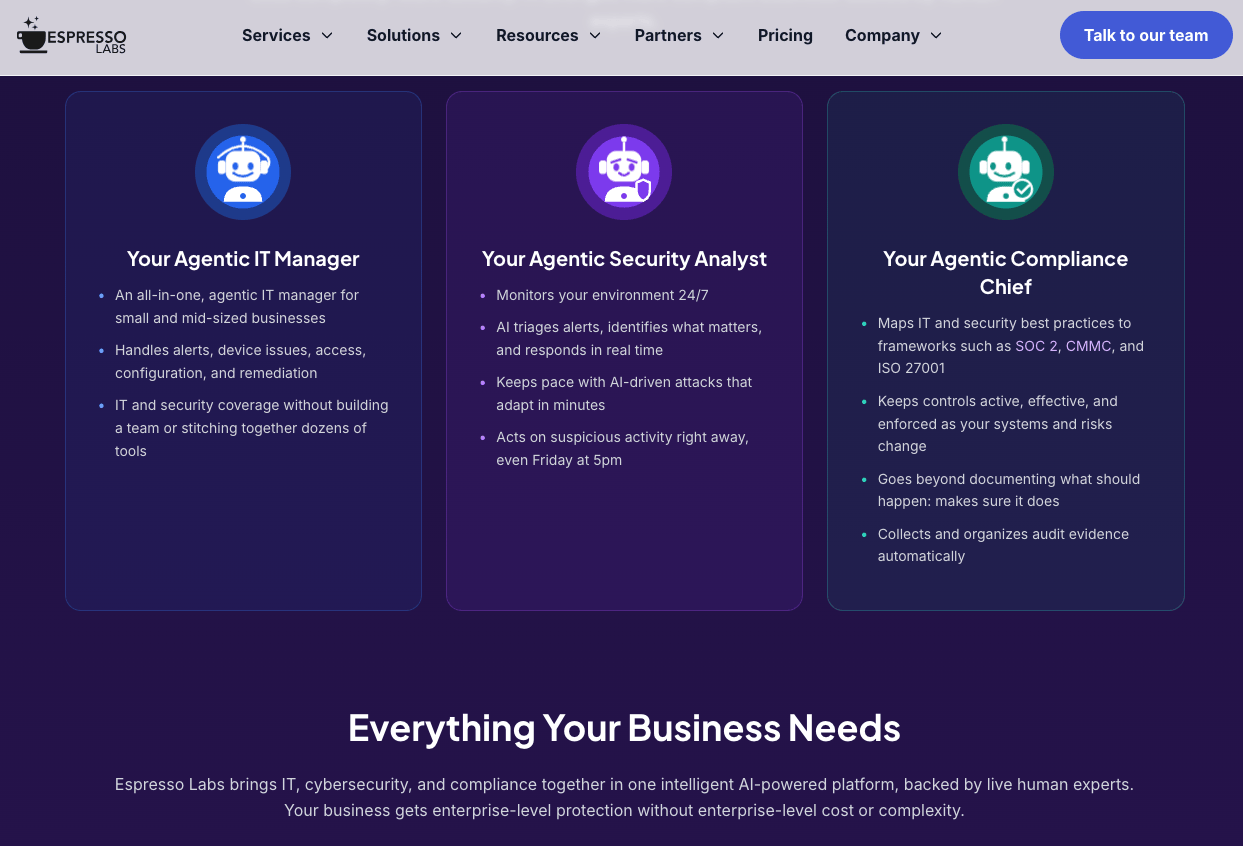
We’re combining AI-driven automation with the underlying IT and security operations needed to make compliance an ongoing process rather than a recurring project.
The goal isn’t another dashboard.
The goal is fewer things for humans to chase, fewer things that can break unnoticed, and much less time between a security requirement and an actual working control.
From cost center to sales engine
This is where I think the conversation gets interesting for founders and CEOs. Most companies look at SOC 2 as an expense.
They calculate the cost of consultants, software, auditors, and engineering time. Then they try to minimize it.
I think that’s the wrong calculation.
The real question is: How much revenue are you losing because you can’t answer security questions quickly enough?
Consider a company selling a healthcare SaaS product.
Before improving its compliance process:
- Security questionnaires take approximately 14 days to complete.
- Enterprise sales cycles average nine months.
- Engineers spend a significant amount of time responding to repetitive security requests.
After implementing a more automated compliance process:
- Questionnaires are completed in under 48 hours.
- Sales cycles drop from nine months to approximately 3.5 months.
- Engineering distraction from compliance-related requests decreases by roughly 80%.
These are the kinds of operational improvements that change the economics of a business.
Think about what happens when you reduce a nine-month sales cycle to three and a half months. You aren’t just saving your engineering team some time. You’re potentially accelerating revenue recognition, improving cash flow, reducing sales friction, and giving your sales team more opportunities to close deals. Suddenly, compliance isn’t just protecting the business from risk.
It’s helping the business grow.
The practical playbook: Three things I’d do tomorrow
You don’t need to rebuild your entire security stack to start thinking differently about this.
Here are three practical actions I’d recommend to any founder or CTO selling to enterprise customers.
1. Measure Security Review Duration (SRD)
Most sales organizations track pipeline velocity, conversion rates, average deal size, and time to close. Very few measure how much time deals spend waiting for security approval. I’d start tracking Security Review Duration (SRD). Measure the time between the first security questionnaire arriving and the customer approving your security review.
Then connect that metric to your CRM.
You might discover that security reviews are adding three weeks, six weeks, or even months to your sales cycle. That’s not an IT metric. That’s a revenue metric. And it deserves the same attention as your sales conversion rate.
2. Identify your top 10 security blockers
Talk to your sales team.
Ask them:
- What are the security questions that repeatedly slow down deals?
- Which documents do customers request most often?
- What questions require engineering involvement?
- Which answers take the longest to produce?
- What causes procurement teams to send another round of questions?
You’ll probably discover that a relatively small number of recurring questions account for most of the friction. Build the answers once.Prepare the evidence. Automate the collection. Keep everything current.
Your sales team shouldn’t need to Slack the CTO every time a prospect asks whether customer data is encrypted at rest.
3. Build your Trust Center before you need one
Here’s a simple test.
Pretend you’re a procurement manager evaluating your company.
Visit your website and try to answer these questions in five minutes:
- Do you have SOC 2?
- What security certifications do you maintain?
- How do you handle customer data?
- Do you have a documented incident response process?
- Can I access your security policies?
- How do I request additional security documentation?
Can your sales representative send a complete security package in under 60 seconds?
If not, you have work to do. A good Trust Center isn’t just a compliance trophy. It’s a sales enablement tool.
Make it easy for customers to trust you.
What AI changes about all of this
There’s another reason I believe this is the right time to rethink compliance. AI fundamentally changes the economics of doing this work. Historically, maintaining compliance required a lot of human coordination. Someone had to collect evidence, compare configurations, review policies, chase employees, prepare responses, and keep everything synchronized.
A lot of this work is repetitive, structured, and increasingly automatable.
AI can help interpret requirements, map them to actual technical controls, collect and analyze evidence, identify gaps, prepare questionnaire responses, and coordinate remediation.
But there’s an important distinction.
Generating a policy with AI isn’t the same as implementing the policy.
Generating an answer to a security questionnaire isn’t the same as proving that the answer is true. And generating a compliance report isn’t the same as maintaining a secure environment. The interesting opportunity isn’t to put a chatbot on top of a GRC dashboard. It’s to build AI-native systems that connect the requirements to the actual infrastructure, identities, endpoints, applications, and security controls.
That’s a much bigger opportunity.
And it’s where I believe the next generation of IT and compliance platforms will be built.
TL;DR
Compliance shouldn’t be a recurring paperwork project that distracts your engineering team and slows down your sales organization.
It should be an automated operating system that continuously implements, monitors, and proves your security posture.
When you get it right, three things happen:
- Your company becomes more secure.
- Your engineering team spends less time on repetitive compliance work.
- Your sales team closes enterprise deals faster.
That’s not a cost center.
That’s a competitive advantage.
The 15-Minute Espresso Break Challenge
Here’s something you can do today. Pick one open enterprise deal.
Ask your AE to send the prospect a complete security package: SOC 2 report (if available), security policies, architecture overview, encryption details, access management information, and answers to the most common security questions.
Start the clock.
Can they do it in under 60 seconds?
If the answer is no, ask yourself how many other deals are waiting on the same information.
And how much engineering time you’re spending answering questions you’ve already answered ten times. At EspressoLabs, we’re building technology to make this entire process dramatically simpler, faster, and more automated. We’re helping companies get SOC 2 ready in weeks, not months, while bringing the underlying IT and security operations together into one AI-native platform.
Because I don’t think companies should have to choose between building great products and proving they’re secure.
They should be able to do both.
Discover more from Ido Green
Subscribe to get the latest posts sent to your email.

