Business

How To Evaluate A Startup?

Why?

It’s mostly depend on the angle you are coming to this good question. If you are the founder, valuation matters because it determines the share of the company you are going to give away (to investors) in exchange for money. If you are the investor, you want to make sure it’s the right deal in terms of risk/reward or give/get.

When you listen to experts in this domain, in most cases, the answer is something like: “It is a form of art rather than science”. But this is not very helpful, is it?

How?

Let’s break the puzzle into few pieces and see how can we think on each one of them. Here are few questions to help us identify what we are doing in each piece. We start with ‘What we  are going to solve’ (=problem) and with ‘How we are going to solve it’ (=solution). Later, we should see what is the potential (=market) and what are the risks (= direct/indirect competitors). We also need to show the team and why it’s capable to deliver. Continue reading


Standard
Android, Chrome, mobile

Earn More Revenue With Firebase And AdMob

grow your userbase

Firebase is a mobile platform that helps you quickly develop high-quality apps, grow your user base, and earn more money. In the slides below, we will focus on the growth part. In other words, we will talk about ways to acquire and engage the right users at the right time.
There are several features that Firebase is giving developers out of the box in order to help with growth:

Continue reading

Standard
Business

Mentoring Entrepreneurs And Developers

Screen Shot 2016-06-16 at 12.51.01 PMIn the past six years I had the pleasure to mentor hundreds of entrepreneurs and developers. For some, as an investor and for others as an external advisor or a domain expert. These days I’m doing it mostly as my day job which is really fun!

Here are some of the lessons learned over time.

If you are an entrepreneur who is asking:
“Why do I need someone to mentor me?”
Well, there are many good reasons, but check the graph below. Continue reading

Standard
Business

Failure Is Part Of The Game

blue in the dessertLast night, I read this article. What I like most was the short paragraph that gave few recent examples of ‘big’ failures:

…With original ideas, failure is inevitable, because it’s impossible to predict how technologies will evolve and tastes will change. Mark Cuban passed on Uber. In the early days of Google, Larry Page and Sergey Brin tried to sell their search engine for less then $2 million, but their potential buyer turned them down. Publishers rejected Harry Potter because it was too long for a children’s book. Executives passed on Seinfeld for having incomplete plot lines and unlikeable characters. Pay a visit to Jerry Seinfeld’s bathroom, and you might find a memo hanging on the wall that calls the pilot episode of Seinfeld “weak” and says “No segment of the audience was eager to watch the show again.”

We know that most startups will fail. Moreover, in many cases, they will fail even if they had a good idea and executed well (see: “Why Startups Succeed” for more details).
So be willing to fail and try again.
You are in a good company.

Standard
Business

How to Start? The Product

Build something people loveThis is the second part of four presentations I did to a course for young entrepreneurs. The slides are as brief as possible because they meant to give just the framework. The real content is pass verbally.
However, the main points to pay attention are:

  • Get users manually at the beginning. It won’t ‘scale’ but that is more than fine. You need at the start to get users (in every way possible as long as you aren’t breaking any laws) and not to expect them to come to you. The notion of ‘if we will build it they will come’ is not working in most cases.
  • Listen to outside users – This is very important in order for you to build something that users love. A lot of users will give you noise, but your role is to extract the signals and shape the product base on that feedback. You should build an engine: Users -> Feedback -> Product improvement

Continue reading

Standard
Business

Monetization Questions For Entrepreneurs #StartupTips

startup office

“The art and science of asking questions is the source of all knowledge” – Thomas Berger

One of the critical times for startup is when it needs to define what will be the path to profitability. It’s a real challenge, and one of the ways to come up with the right plan is to ask the right questions.

A set of questions that could lead you in the right path:

  1. How do you define the relationship between ‘growth’ and monetization for your startup?
    Do we need to focus on one first?
    What is the mark to blend the two?
    Can we do both?
  2. What do you think about ‘starting a business’ and not ‘starting a startup’?
    The main point here is to get out of the ‘la-la land’ of startups that don’t need ‘revenue’ and look at the world of building a profitable business from the get-go.
  3. What other bold/good/recent startup(s) are executing a good monetization plan?
    Can we do something similar? Which parts of their plan we wish to test first?
  4. Are there several platforms that we can leverage in our monetization paths?
    In other words, if we are a startup that is building an application for iOS/Android.
    Can we also create an amazing web experience and enjoy it as another platform for engagement?
  5. How your purchasing process (or billing) is working today?
    What pitfalls other should learn from it?
    How you optimize it?
  6. Where are the gaps (or opportunities) in the current state of your online commerce?
  7. What are the top 3 action items that you can take in order to monetize your work better at this stage?
    This might be a great question to ask every 1-3 months.
    Moreover, you might want to keep A/B testing your actions.
  8. Any interesting trends you see in the market around your startup?
    What are the leaders doing?
    What other direct competitors are doing?
    What are indirect competitors are doing?
  9. Can we improve the usage of our analytics in order to gain more insights for our KPIs?

For more thoughts on the subject (with some tips from experience) – Join 4100+ students and check out my course on Udacity “App Monetization“.

Good luck!

Standard
Android, Business, Chrome

App Monetization Course #StartupTips

app-mon-imageIn the past year, I had the pleasure to work with  and the rest of the professional team in Udacity on a course that aim to help developers and entrepreneurs. There is no higher form of user validation than having customers support your product with their wallets. However, the path to a profitable business is not necessarily an easy one. This course blends instruction with real-life examples to help you effectively develop, implement, and measure your monetization strategy, iterating on the model as appropriate. In a nutshell, it will help you make money.

Go try it at: udacity.com/course/app-monetization–ud518

Continue reading

Standard
Business

Why Startups Succeed #StartupTips

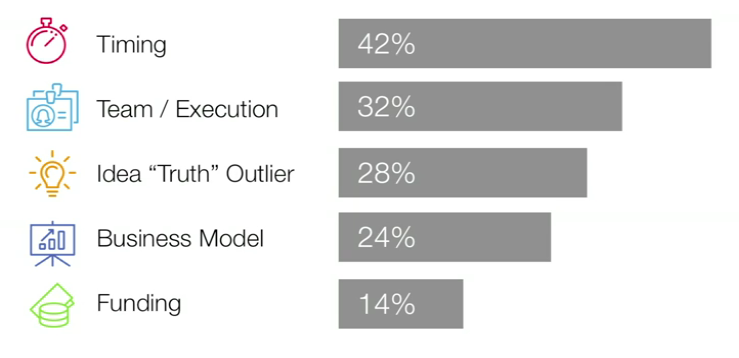
A tree in the wildHow to know if a startup will succeed? Or in other words, when you coming to evaluate a new early stage startup what are the parameters you should consider?

Bill Gross from Idealab did a (limited) research and found out that timing is the most important aspect for startups to succeed. It’s a downer since it’s a factor that we (= entrepreneurs) can’t control. However, a talented team will know how to execute well and ‘buy’ more time. In order to extend the ‘time frame’ as long as we need it to be, a strong business model is another important aspect. It will ensure that we will get to a cash flow positive state. This will enable us to run for years and wait for the right timing.

startup success aspects


IMO, a great execution by passionate co-founders is the best predictor.
After that, a solid business model and a good idea are critical success factors. Continue reading

Standard
Business

Valuation Vs Terms #startupTips

The startup bridgeYoung entrepreneurs (at age or at heart – It doesn’t matter) are very sensitive about valuation or in their eyes: “how much I’m going to get diluted”. After doing several deals both as co-founder and as investor, it became clear to me that it’s the wrong thing to focus on. Moreover, in such an early stage of a startup, no one can do a valuation. It’s all guesses. So the numbers and the arguments over them are ridiculous. What I do find important, are the terms. The ‘little’ details in the term sheet that will drive the future outcomes.

Terms matter

You need to understand what is the meaning of each basic concept like: liquidation, participation, ratchets and preferred shares.
Let’s have a quick look. Continue reading

Standard
Business, webdev

Pick the Right Tool #StartupTips

Which tool to choose?

What is the best tool to do X?

Over the years, I’ve learn that if you are using the right tools and really master them – You become 10x better at what you do. This post is a short list of tools that entrepreneurs, developers, designers and ‘startups people’ might find useful. It base on my personal experience, so (of crouse) there are many other good options out there. The best advice is to try few tools and see what is working for you.

Cloud Platforms

It doesn’t matter if you are building for the web or for mobile platforms (Android, iOS). In the end of the day, you will need a ‘server side’ and hopefully it will be on an infrastructure you can trust for: performance, scale, redundancy, security, easy of usage etc’. I’ve used the first three cloud providers in the list. I really like the power of App Engine. Although, you will need to work in the ‘app engine way’ and not your own. If you need certain capabilities that app engine is not supporting, I suggest trying one of the IAAS options.

  • Google App Engine – I recommend this option because it gives you great ways to focus on your product and not administrative server tasks. Another good option is Google’s infrastructure as a service in the name of Compute Engine that will give you the freedom to have a clean server to work with.
  • Rackspace – Got nice sets of options for hosting and deployments. I’ve used them in my last startup (HighGearMedia) and they had a good value proposition.
  • Amazon Web Services – The current leader of cloud computing.
  • Microsoft Azure – If you like MS technology stack.
  • Pivotal – Cloud Foundry is the result of an industry efforts to build an open platform as a service.
  • Heroku – Supports Ruby, Node.js, Python, Java, and PHP so you can use the languages you know.

In the diagram below you can gain a good view of all the options on Google Cloud Platform. Continue reading

Standard