Chrome, HTML5, webdev

HTML5 Training Day (Mountain View) – Summary

Well, in the past month I was busy organizing this HTML5 Training Day for business web developers. You may want to stop and ask:
What Is HTML5 Training Day? So, our main goal is to have an open conversation with business web developers and to provide them with tools and knowledge to implement HTML5 features into their web apps. In this one day event, world-class experts talk about tools, tips and best practices in web development with focus on business.

It was a lot of fun and last week, we had in Google more then 24 companies that came to learn about the latest and greatest in the open web technologies.

We started the day with a short presentation that I gave on ‘The State of ChromeOS’. It’s amazing to see how fast is the pace and I suspect we are going to have a great 2012. After that (and two more cups of coffee) we got Pete LaPege (an excellent speaker, if I may) talking about: “HTML5 and new breed of web application” which aim to cover what defines a great Web App and show you how you can use HTML5 to create a new breed of web application that will delight and amaze your users.

Another cup of java and another web ninja: Mr. Eric Bidelman gave great talk with lots of demo on the ‘bleeding edge features in Chrome and the open web platform“.
and some HTML5 offline features. 

For the developers who wish to do ‘mobile first’ – we had a surprise from the snow country. Mr. Boris Smus (that build web stuff that make you – wow! for real) talking about A mobile web app technology stack. Here in his own words: “…Learn what it takes to build modern mobile web apps. We will start with the ideas of “adaptive apps” and “offline first”. Next, we’ll dive into some of the technologies, including MVC frameworks, templating engines, CSS frameworks, laying out views and multi-touch input. Finally, we’ll close off with mobile-specific tips and sweet demos.”

After Boris we had the pleasure to host David Kaneda (for the few that don’t know, David Kaneda is a creative web technologist. He created jQTouch, a jQuery plugin for mobile web development, and Outpost, the original iPhone app for Basecamp.) David gave another great talk on “Abstracting CSS for Complex Theming Systems.”

In the afternoon, Mr. Seth Ladd (The Michael Jordan of Dart) spoke about Dart and how it is a comprehensive effort to help app developers build complex, full featured, high fidelity apps for the modern web. He gave some nice short demos that showed the language, libraries, and editor of Dart.

Last but not least, Mr. Christos Apartoglou (The Chrome Web Store Chief) spoke about  Success stories in CWS. He talked about some bold success stories and showed what makes apps in the Chrome Web Store successful.

You can see the format of the day with the full descriptions of the talks over the public schedule that we kept for that day. It was a good tool to have a back channel (using the chat feature on the document) and to allow everyone to keep updated with the last minute changes. I hope to have some videos from that day public… I will post them here and on my G+ page.

See you all in our next Training day.

Standard
Chrome, HTML5

Google Developers Days (Tel Aviv & Berlin) And One CloudCon

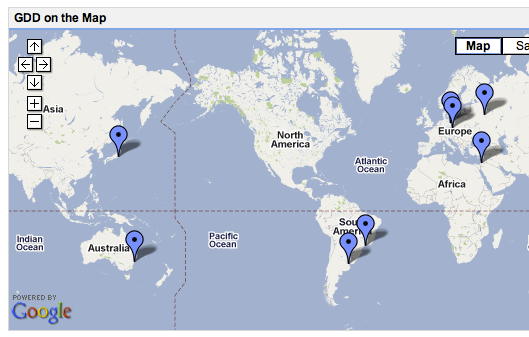
It was a busy week. Busy but with lots of fun. It’s so great to meet wonderful developers that push the web forward and know (and love) their profession. Last sunday, we had Google Developers Day in Tel Aviv (or Airport city if you want to be accurate) – it was well organized event with more then 1400 developers. In the keynote we had three demos:

  • Android – Ice cream sandwich new capabilities (maps, nfc, HD and other features. To dive deeper, go check Romain Guy’s blog).
  • Chrome/HTML5 amazing new features – I did the demos and I hope to post a list next week.
  • G+ – the new hangout APIs with a robot that eat falafel and drink beers.
Here you can check some coverage:
 The CloudCon was also impressive in terms of the audience (mainly, CIO/CTO dudes) – they liked the story of HTML5 and ChromeOS. I got some good questions on new features: offline, notifications, threads and even on web audio. It could be great to have the new Chromebooks in Israel, it seems that the market really want them. The one argument (or selling point if you want to push here) that conviense IT people is that the TCO (=Total cost of ownership) is 60%-70% cheaper. Yes – these are the numbers… so if your organization can work with web apps (and Citrix for the apps that you don’t want to move to the web) it might be a perfect solution for you.

I hope to get some photos soon (from our dear wonderful photographer) – so I’ll update this post with fresh photos of some great looking people.

Tomorrow we are going to rock Berlin – so keep up with us using G+ with #GDD11 tag  or this blog next week. Btw, for Berlin GDD you might want to search after #GDDDE

Be strong.

This slideshow requires JavaScript.

In case you want to follow the slides from my Talk in CloudCon – The ‘love’ story of HTML5 & ChromeOS.

From Google Developers Day in Berlin here are the talks:

Standard
HTML5, JavaScript, webdev

Open Call for Google Developer Day In The Theaters Near You

It’s going to be a hot summer all around block (=world). If you are a (really good) developer… this is a great opportunity to show the world what magic you can do. It’s all about APIs and how you master their usage with some ‘salt & paper’ that you bring from home. This year’s Open Call challenges will focus on the Android ADK and HTML5 platforms. No matter which challenge you choose, your submission must reflect the regional culture of the GDD that you will be attending, be this through music, creative imagery, lighting or colors… go with your heart.

Important Questions & Answers

    • Who is eligible to participate in Open Call? Submissions will be showcased at their respective GDD event, so you must be able to physically attend the event. In most cases, this will mean that a German developer will submit an Open Call for GDD Berlin–however, if a developer from France plans to attend in Berlin, they are also welcome to send in a submission. While not a requirement, all of the challenges will require in-depth knowledge of developer tools and Google products, so we suggest that you have proficiency in those a
    • My country is not represented at GDD. Can I submit an Open Call anyways?All Open Call submissions must be relevant to the local markets where hosting GDDs.
  • What dates will the challenges run and which products are participating? What is the timeline for the challenges?The Android ADK Open Call will
    be announn Monday, July 18 at 9:00 A.M. PDT
    The HTML5 Open Call will be announced on Monday, August 1 at 9:00 A.M. PDT
Few resources to keep you moving forward are: html5 demos, the great HTML5 Docs on MDN and of course our very own HTML5 Rocks

Here is the official site for GDD and remember to have fun. 


Standard
webdev

What Is The Right Cloud For You?

In the past few years we saw lots of ‘clouds’ coming up to life. Some of the known and powerful ones like:

  • Amazon S3 – Amazon S3 is storage for the Internet. It is designed to make web-scale computing easier for developers. Amazon S3 provides a simple web services interface that can be used to store and retrieve any amount of data, at any time, from anywhere on the web. It gives any developer access to the same highly scalable, reliable, secure, fast, inexpensive infrastructure that Amazon uses to run its own global network of web sites. The service aims to maximize benefits of scale and to pass those benefits on to developers.
  • Rackspace Cloud – They offering servers, files and load balancers. It’s similar to amazon and you get some nice features ‘for free’ – like the ability to take images of your current machine and start new ones from this image.
  • Amazon EC2 – Amazon Elastic Compute Cloud (Amazon EC2) is a web service that provides resizable compute capacity in the cloud. It is designed to make web-scale computing easier for developers. Amazon EC2’s simple web service interface allows you to obtain and configure capacity with minimal friction. It provides you with complete control of your computing resources and lets you run on Amazon’s proven computing environment. Amazon EC2 reduces the time required to obtain and boot new server instances to minutes, allowing you to quickly scale capacity, both up and down, as your computing requirements change. Amazon EC2 changes the economics of computing by allowing you to pay only for capacity that you actually use. Amazon EC2 provides developers the tools to build failure resilient applications and isolate themselves from common failure scenarios.
  • Amazon Cloud front – Amazon CloudFront is a web service for content delivery. It a ‘pure man’ solution for other CDN. It integrates with other Amazon Web Services to give developers and businesses an easy way to distribute content to end users with low latency, high data transfer speeds, and no commitments.
  • Microsoft Azure – Offering the .NET developers a ground play with all microsoft technologies. If you live inside microsoft stack (MSSQL, .NET etc’) – I guess this is the place you want to research first thing. However, since other cloud solution also give you MS environments, it’s not the only solution. So take the time and do a good research on the different offerings.
  • Google App Engine – Google App Engine enables you to build and host web apps on the same systems that power Google applications. App Engine offers fast development and deployment; simple administration, with no need to worry about hardware, patches or backups; and effortless scalability.
BTW, they are many many more… I know. I’ve put in the bottom of the post ‘just’ the ones that Amazon offering so you could get the picture of ‘how many’ different types of cloud we have today at 2011 just from one (big) vendor.
There are very different in their ‘view of the world’ and like in anything in life, you need to define your own goals before you going to choose a solution.
Standard
life

What If Compassion Was Fun And Profitable?

Great TED talk about compassion in Google. It shows the happiest man in the world (for real) and how ‘level 5’ leaders (humble + ambition) can create a huge change in life.

I liked the fact that Chade-Meng Tan talked about ‘search inside yourself’ (after all, he is from the search giant).

His  main steps are: Search inside yourself: Attention -> quality mind (=clear) -> self knowledge -> Focus on happiness (of the other).

‘if you want others to be happy, proactive compassion. if you want to be happy, proactive compassion.’ – Dalai Lama

Standard
JavaScript, webdev

Create Your Own Chrome Extension To Any Web Page

It’s now very clear that Chrome Browser got huge adoption (I guess the current numbers of active users is around 100M). In case you didn’t know, Google got now an App store to chrome. They basically, take what Apple showed the world in terms of building an Eco system (apps that you, as developer, can monetize on their platform) and trying to do the same with chrome as platform. It’s very smart idea and soon when we will see the chrome OS on tablets – this will be the way to manage your apps. The main APIs that you might want to use are: Browser actions and Page actions.

Browser Actions – you should use browser actions to put icons in the main Google Chrome toolbar. It’s for actions you wish to add to the browser (not specific page). Here are the main tips in order to use it right:

  • Do use browser actions for features that make sense on most pages.
  • Do use big, colorful icons that make the most of the 19×19-pixel space. Browser action icons should seem a little bigger and heavier than page action icons.
  • Do use alpha transparency to add soft edges to your icon. Because many people use themes, your icon should look nice on a variety of background colors.
  • Don’t use browser actions for features that make sense for only a few pages. Use page actions instead.

Page Actions – Page actions represent actions that can be taken on the current page, but that aren’t applicable to all pages. For example: translate content on the page, create something from photos in the page etc’. Here are some samples for both type of extensions.

Now, if you are on a site that you think will make sense to put in an extension (due to it’s nice features)… it’s very easy to do it.
All you need are two main files:

  1. manifest.json – this file is the description of the extension. Some meta info…
  2. Create a simple deals.html page (in our case it’s all about good deals for cars) that will include the web page you wish to have as an iframe.

Here are the 2 files that show you how to take HGM mobile app and put it in chrome:

manifest.json

{
"name": "Great Deals on New Cars",
"version": "0.2",
"description": "Great the best prices on your new car",
"icons": { "128": "app_icon.png" },
"browser_action": {
"default_title": "Great Deals on New Cars",
"default_icon": "deals.png",
"popup": "deals.html"
},
"permissions": [   "http://www.thecarconnection.com/*" ]
}

deals.html


<!DOCTYPE html>
<html>
<head>
<title>Deals</title>
<meta name="author" content="Ido Green">
</head>
<body>
<iframe src="http://beta.thecarconnection.com/conduit/deals" width="510px" height="700px" border="0px" scrolling="no">
</body>
</html>

After you saved these 2 files in one directory, just go to Chrome and click on ‘Windows’ -> ‘Extensions’. In that page you click on ‘Load unpack extension…’ and point to your directory.
Done.
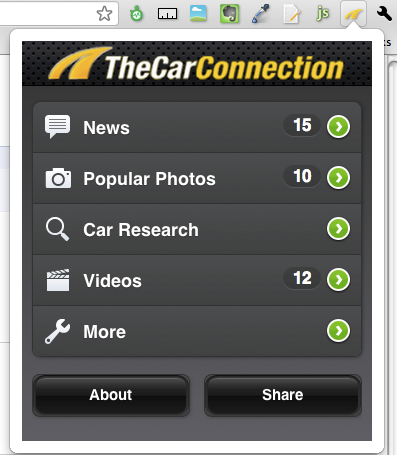
You should get now a new button and if you click on it you should get something like this:

another easy option is to go and download this extension.

Happy Friday/coding.

Standard
Business

The Web Is Shifting

Here is another lighting talk I’ve planed to this year Java Posse Roundup. Unfortunately, I didn’t have time to give it. So in order to share it with some girls that might find it interesting – Here you go:

The web is becoming more sociable than searchable, research firm Hitwise said that the two sites accounted for 14 per cent of all US internet visits last week. Facebook’s home page recorded 7.07 per cent of traffic and Google’s 7.03 per cent. You may  read more about the fact that Facebook got more unique users in the USA then Google all last week… so it’s clearly the direction that the web is moving. I only wonder, what are people doing all this time on Facebook.

Facebook is like a Starbucks (You know… friends don’t let they friend drink there) where everyone hangs out for hours but almost never buys anything. The revenue gap between sites like Facebook and Google should narrow over time.  Cost-per-click search ads are extremely good at harvesting intent, but bad at generating intent.

Standard
webdev

Google – Microsoft is moving fast behind you

Very impressive (and short) talk at TED that show that maps.bing.com is moving fast in the direction of Google maps.

Standard