Chrome, HTML5, JavaScript, webdev

Web Fundamental Update

Here are the slides from a talk I gave at Campus TLV. It’s a summary of web fundamentals is offering developers at the first step of ‘building your first multi screen site‘.

If you would like to contribute to this important open-source project, please jump to our github repo: github.com/google/WebFundamentals


Standard
Business, Chrome

Web Monetization Options

TL;DR

Today there are many choices when it comes to make money on the web.

  • In-app payments – There are many examples to an application that is free but let you add features with in-app payments. A good example is a game that is free, but offers additional levels or virtual goods for a certain price.
  • One-time charge – You charge a fixed price for your application. It could be before the user tries it or after a period of ‘testing’.
  • Subscription – There could be monthly or yearly subscription models. Users will pay as they go. Many SMB applications are working this way.
  • Freemium – In this pricing strategy we can use each of the previous options. The advantage in it is that we are offering a limited trial version of our app so users could ‘test before they buy’ and offer a ‘pro version’ for those who wish to buy the full application.
  • Ads – There are many options and we will cover it in the future.

Google Wallet on all devices

Let’s take a closer look at each option and see when and how to use it. Continue reading

Standard
Chrome, JavaScript

The Little Prince And The Better Parts Of Javascript

The little price“It seems that perfection is attained not when there is nothing more to add, but when there is nothing more to subtract.”

In this (quality talk), Douglas Crockford talks on the better parts of JavaScript. As always, it’s an opinionated talk, so choose what you wish to take from it for your next project. There are many aspects that Douglas touch on, that are very helpful to any technology you are using. I truly like his opening from “The little prince” ‎- Antoine de Saint-Exupéry. Great points on software development and especially JavaScript’s holes you wish to avoid.

Btw, back at 2010 I’ve recommended his book – Times fly.


Standard
Chrome

DLD TLV And Frontend Development (In Hebrew)

Screenshot 2014-09-16 20.25.37Today, I’m going to be at DLD TLV – if you are around…

Please come to say hello.

Continue reading

Standard
Chrome, HTML5, JavaScript, webdev

uptodate.frontendrescue.org just got a hebrew version

fed-uptodate-hebrewI’ve been contributing to this cool project: github.com/frontend-rescue/keep-up-to-date and today it’s live!

If you wish to check what are the best practices for front-end developers (in hebrew) this is your version: http://uptodate.frontendrescue.org/he/

Good luck.

Standard
Chrome, JavaScript, webdev

How To Create A RESTful API

Google APIs with picturesque app

If you wish to read the background on RESTful APIs It’s all started here.  You can look at some good examples for RESTful APIs from Google, Twitter and many others. In this post, I will try to focus on some important aspect that you want to keep in mind when you are building your next RESTful API. Btw, if you are looking on an efficient way to create it – Checkout my talk from last Google I/O. It’s over a year now, but still very relevant.

Main aspects to pay attention

Continue reading

Standard
Chrome, mobile, webdev

A List Of Great Mobile Web Apps

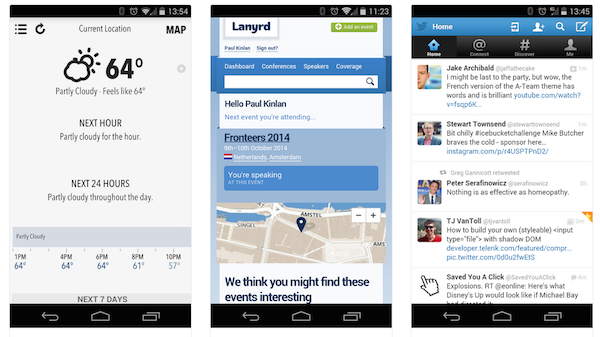
mwa-examples 2014-08-21 14.16.36In the past, I gave few presentations on ‘Modern web apps‘ and each time I tried to show compelling examples.

Here is a new source (mobile web apps ftw) that might help you see what can be done (today) on the mobile web.
Few good examples to checkout:

  1. Weather App
  2. Lanyrd (For your next conferences).
  3. Stanford
  4. Financial Times
  5. Alerts in Israel (hebrew)
  6. Time Tracker (hebrew)
  7. GitHub
  8. Twitter
  9. Gmail

Another good site to get insperation is: mobile-patterns.com
If you have other great suggestions – please use the comments and I’ll add them.

Standard
Chrome

Opera Mini to nurse Microsoft’s feature phones through their dying days

Great news for the mobile web.
As Opera jump on Blink few months ago, it will be great to have this powerful engine on Microsoft phones as well.

David Meyer's avatarGigaom

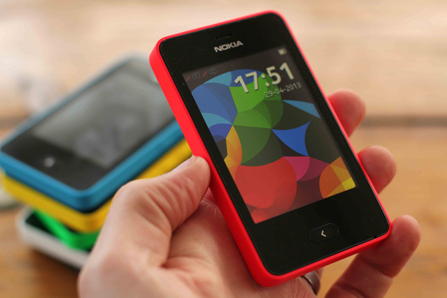
Opera has inked another deal with Microsoft – after Opera’s full-fat mobile product became the default browser on the Nokia X2 Android handset, Opera Mini will now be the default on Microsoft’s feature phones on the Asha, Series 30+ and Series 40 platforms.

The eagle-eyed among you will have spotted a slightly limiting factor in all this: [company]Microsoft[/company] is killing off almost all of these devices — extremely low-end Series 30+ devices like the newly-launched Nokia 130 may survive a while longer — in a push to take Windows Phone towards the bottom of the market.

But it will be a slow death, over the next year and a half or so, and Opera will be there for their twilight, gently shoving the currently-default Xpress Browser to the side.

“Users will begin to receive notifications on their phone starting October 2014, providing them with information on how to upgrade from…

View original post 97 more words

Standard
Chrome, HTML5, JavaScript, mobile, webdev

Israel’s Alerts – Mobile Web App Example

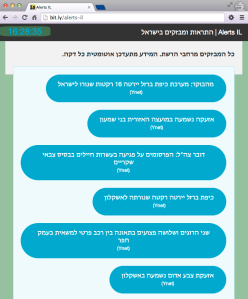
Alerts IL - mobile web app

If you wish to have a window on the side of your screen and/or leave your mobile device on a page that will show you an updated list of all the alerts (Tzeva Adom and others) – Here is a web app for you. It is based on Foundation CSS framework as it’s ‘mobile first ‘ and got a very powerful grid system.

Code

Check out the Alerts-IL GitHub repo or the Google App Engine version.

If you wish to see the Android app code github.com/greenido/Alerts-IL-Android which is a simple native app that wrap the mobile web app.

Continue reading

Standard
Chrome, JavaScript, webdev

(Try To) Predict The World Cup With Monte Carlo Simulation

brazil 2014 world cupWho will win this world cup? Brazil without Neymar? Lionel Messi? Or are we going to see the Nederland making a big surprise?

If you like coding, statistics and problems that are not trivial… You found the right place. In this post, I will try to show an example to a way for solving this type of questions. For the readers that don’t remember what is Monte Carlo simulation (don’t be shy) – You might want to check a previous post that I wrote last summer and give you an intro to the world of Monte Carlo on Apps script and Google compute engine.

Monte Carlo experiments (simulations) are a broad class of computational algorithms that rely on repeated random sampling to obtain numerical results. In most cases, we will run our simulations many times over in order to obtain the distribution of an unknown probabilistic entity.  This tool is often used in physical and mathematical problems and are most useful when it is difficult or impossible to obtain a closed-form expression, or infeasible to apply a deterministic algorithm.
In the real world, we see it being mainly used in three distinct problem classes:
* Optimization.
* Numerical integration.
* Generation of draws from a probability distribution.


OK, there is no time. The game starts in two days.

The Idea

Monte Carlo simulations tend to follow a particular pattern. Here is how we will use this tool: Continue reading

Standard