
The Science
This 7-day pre-race plan exists for one simple reason:
to get you to the start line slightly bored, mildly twitchy, and annoyingly fresh –> That’s the “sweet spot”.
It’s built on two ideas that sports science actually agrees on (a rare event):
tapering and nutrition periodization.
No crystals.
No miracle powders.
Just physiology doing its thing if you don’t mess with it.
Training Taper: Doing Less Is a Skill
Tapering is the controlled art of not ruining months of work in the final week.
Studies consistently show a proper taper can improve performance by ~2–3%. That doesn’t sound sexy, but over 100 miles it’s the difference between “strong finish” and “why are my legs negotiating with me?”
What’s happening under the hood:
- Your muscles finally repair all that microscopic damage you’ve been collecting like Pokémon.
- Glycogen stores refill properly instead of being half-empty all the time.
- Fatigue drops while fitness mostly stays put (fitness is sticky; fatigue is fragile).
- Your brain stops screaming “threat detected” every time you see elevation gain.
The hardest part isn’t the physiology.
It’s resisting the urge to “just do one more hard ride.”
That urge is your enemy wearing your own face.
Nutrition Periodization: Fueling, Not Experimenting
Race week is not the time to discover you’re “sensitive to lentils.”
The nutrition side of this plan exists to make sure your engine is full, predictable, and boring—in the best possible way.
Carbohydrates creep up so your muscles start the race fully stocked instead of half-drained.
Hydration is about balance, not turning yourself into a walking water balloon.
Fiber comes down so your gut doesn’t attempt a coup at mile 63.
Foods stay familiar because surprises are great in movies and terrible in bib shorts.
Nothing fancy here.
Just setting conditions so your body can do what it already knows how to do.
What You Get If You Actually Follow the Plan
You start the race feeling rested instead of vaguely broken.
Your risk of doing something stupid to a tendon drops dramatically.
Recovery improves because your body isn’t fighting a calorie deficit while tapering.
Confidence goes up because uncertainty goes down.
Glycogen stores hit that “supercompensation” zone endurance athletes chase for a reason.
Plus, your stomach behaves like an adult and Hydration is dialed, not guessed.
In short: fewer variables, fewer excuses.
What Happens If You Wing It
You show up tired because you trained “just a little too hard.”
Something starts whispering in a knee, Achilles, or lower back.
You bonk early because glycogen loading sounded optional.
You either under-drink or over-drink and feel weird all day.
Your gut rebels because race week suddenly became culinary improv night.
Stress spikes because there’s no plan to trust.
Your immune system waves a tiny white flag right before race day.
None of this is theoretical.
We’ve all seen it.
Some of us have been it.
The Bottom Line
This 7-day plan isn’t magic.
It’s respect—for the training you already did, for basic biology, and for the fact that long races punish small mistakes.
Follow the structure.
Trust the process.
Make small adjustments if your body asks nicely, not if your ego shouts loudly.
The goal is simple: arrive at the start line rested, fueled, mentally clear, and slightly annoyed that you’re not allowed to train harder.
That’s when good races happen.
Now go do the hardest thing this week: nothing extra.
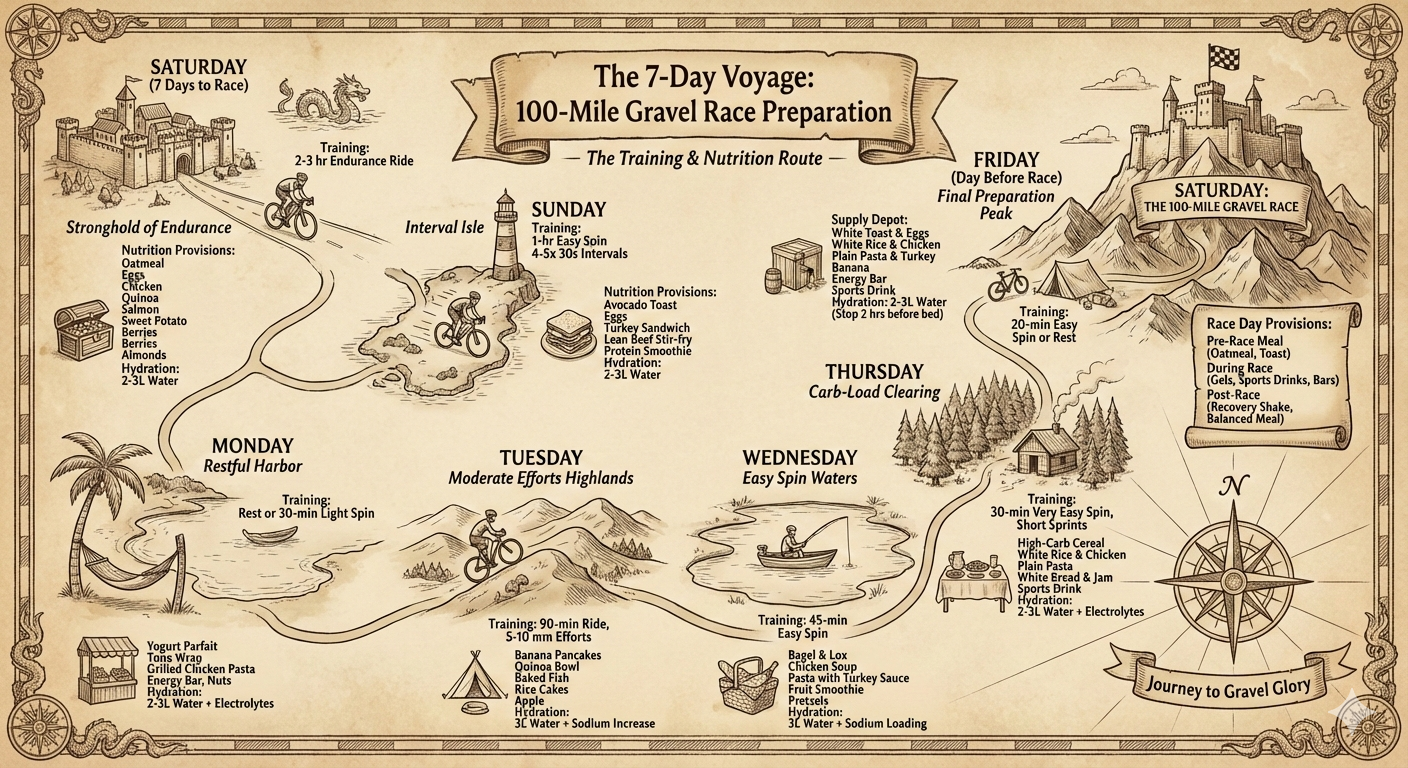
7-Day Pre-Race Training and Nutrition Plan for 100-Mile Gravel Race
Saturday (Today, 7 days before race)
Training: 2-3 hour endurance ride at moderate intensity.
This is your last long ride before the race, so treat it as a full race rehearsal:
- Use the exact bike setup and equipment you’ll race with (including aero position if applicable).
- Wear the same clothing and kit you’ll use on race day (helmet, shoes, glasses, etc.).
- Practice your race nutrition and hydration plan: test gels, bars, sports drinks, dates, or whatever fuel you’ll rely on during the event. Aim to consume the same quantity and timing as planned for the race.
- Simulate race-day routines where possible (e.g., pre-ride meal, warming up).
Focus on consistency, comfort, and confidence – this ride is about dialing in your setup and strategy, not pushing hard.
Nutrition:
- Breakfast: Oatmeal with banana, honey, and chia seeds; 2 scrambled eggs
- Lunch: Grilled chicken breast, quinoa, roasted vegetables
- Dinner: Salmon, sweet potato, steamed broccoli
- Snacks: Greek yogurt with berries, handful of almonds
- Hydration: Aim for 2-3 liters of water (with
Sunday
Training: 1-hour easy spin with 4-5 short (30-second) high-intensity intervals
Nutrition:
- Breakfast: Whole grain toast with avocado and poached eggs
- Lunch: Turkey and cheese sandwich on whole grain bread, apple
- Dinner: Lean beef stir-fry with mixed vegetables and brown rice
- Snacks: Protein smoothie (whey protein, banana, spinach, almond milk)
- Hydration: 2-3 liters of water
Monday
Training: Rest day or very light 30-minute spin
Nutrition:
- Breakfast: Greek yogurt parfait with granola and mixed berries
- Lunch: Tuna salad wrap with whole wheat tortilla, carrot sticks
- Dinner: Grilled chicken, pasta with tomato sauce, side salad
- Snacks: Energy bar, handful of mixed nuts
- Hydration: 2-3 liters of water, include an electrolyte drink
Tuesday
Training: 90-minute ride with a few moderate efforts (5-10 minutes each)
Nutrition:
- Breakfast: Banana pancakes (2 eggs, 1 mashed banana, cinnamon)
- Lunch: Quinoa bowl with chickpeas, roasted vegetables, and tahini dressing
- Dinner: Baked white fish, rice pilaf, steamed green beans
- Snacks: Rice cakes with almond butter, sliced apple
- Hydration: 3 liters of water, increase sodium intake slightly
Wednesday
Training: 45-minute easy spin
Nutrition:
- Breakfast: Bagel with cream cheese, smoked salmon, and cucumber
- Lunch: Chicken and vegetable soup, whole grain crackers
- Dinner: Pasta with lean ground turkey meat sauce, side salad
- Snacks: Fruit smoothie, pretzels
- Hydration: 3 liters of water, continue sodium loading
Thursday
Training: 30-minute very easy spin with a couple of short sprints to keep legs fresh
Nutrition:
- Breakfast: High-carb cereal with milk, sliced banana, and honey
- Lunch: White rice, grilled chicken breast, steamed carrots (low fiber)
- Dinner: Plain pasta with olive oil and parmesan, lean protein (chicken or fish)
- Snacks: White bread with jam, sports drink
- Hydration: 2-3 liters of water, electrolyte drinks
Friday (Day before race)
Training: 20-minute easy spin or complete rest
Nutrition:
- Breakfast: White toast with honey, scrambled eggs
- Lunch: White rice, baked chicken breast (no skin), well-cooked zucchini
- Dinner: Plain pasta with a small amount of sauce, lean ground turkey
- Snacks: Banana, energy bar, sports drink
- Hydration: 2-3 liters of water throughout the day, but stop 2 hours before bed
Saturday (Race Day)
Training: 100-mile gravel race
Nutrition:
- Pre-race meal (3 hours before): Oatmeal with honey, banana, and a small amount of peanut butter; white toast with jam
- During race: Energy gels every 45-60 minutes, sports drinks, easily digestible energy bars or bananas as needed
- Post-race: Recovery shake within 30 minutes, followed by a balanced meal with lean protein and carbs within 2 hours
Remember to test any new foods or drinks well before race day to ensure they don’t cause any digestive issues. Good luck with your race!
Discover more from Ido Green
Subscribe to get the latest posts sent to your email.
 Ido Green