
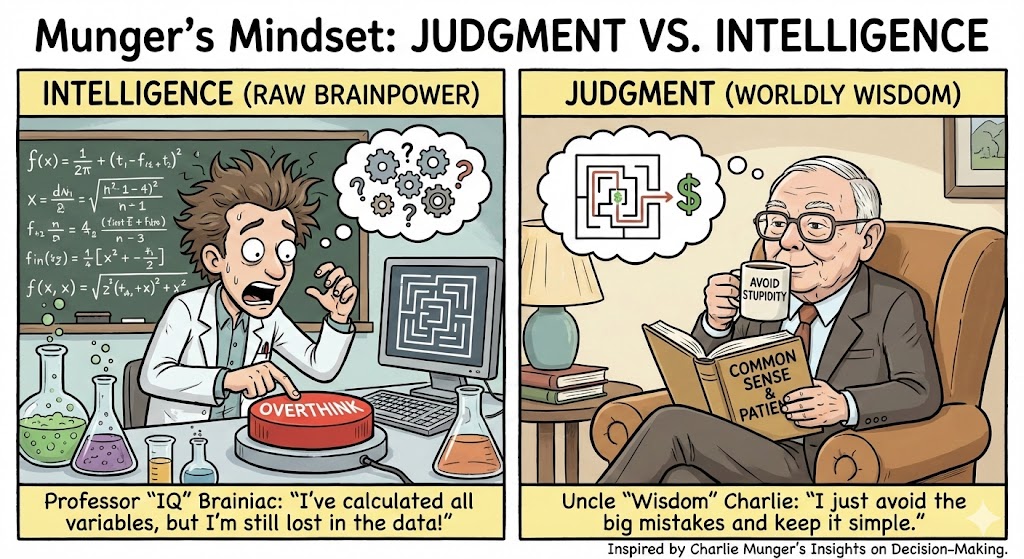
Charlie Munger spent nearly a century studying how humans outsmart… themselves. The man treated bad decisions the way a forensic detective treats fingerprints. And the funny part? Most of the traps he identified hit smart people harder than everyone else. Intelligence doesn’t protect you—it just lets you come up with more elegant ways to be wrong.
Here’s the Munger playbook, rewritten in plain English and spiced with some real-world bruises. Ahh… it’s also much shorter then the original work. However, you do with to read the original as he is much better writer.
Let’s start with the elephant Munger kept in the room: brains aren’t the bottleneck—judgment is. You can have a rocket scientist mind and still steer straight into a mountain if you use it wrong.
1. Using One Mental Model Is Like Using One Dumbbell
When someone only uses the tools from their field, they distort reality to fit their toolbox.
Think of brilliant engineers who start a company and believe everything is an optimization problem. They end up applying A/B tests to human beings, culture, and morale… then wonder why everyone quits. They’re not wrong—just incomplete.
Biology, psychology, and basic common sense matter. A lot.
Tesla’s Cybertruck launch?
Elegant engineering, questionable physics of “just throw a metal ball at the window, what could go wrong?”
2. Incentives Are the Jedi Mind Trick of Human Behavior
People swear they’re driven by principles, values, or vision boards.
Then incentives show up and flip the table.
Doctors over prescribing certain procedures? Incentives.
Bankers selling products they don’t understand? Incentives.
You can explain half of capitalism by asking: “Who got a bonus from this?”
It’s one of the most important questions to ask.
3. Biases Don’t Care How Smart You Are
Everyone thinks confirmation bias is something other people suffer from.
Ever see an investor justify a terrible startup investment because one metric is green?
Or a CEO convinced a product is brilliant because they personally love it—even though churn is screaming in pink neon?
Brains are great.
Brains with blind spots? That’s where the fun begins.
4. Ideology Makes People Weird
Munger nailed it: ideology is like wearing VR goggles with the wrong game loaded.
You stop seeing reality—just whatever fits the narrative.
Tech maximalists swear AI will solve loneliness.
Crypto maximalists swear blockchain will fix parking tickets.
Political extremists think the other side controls the weather.
Once ideology grabs the wheel, facts become furniture.
5. Envy Is the Stupid Tax We Pay Voluntarily
You’re doing well… until your neighbor buys a slightly nicer car. Suddenly you need a Tesla Plaid because “it’s safer” and “good for the environment,” when really you just don’t want to lose the imaginary race.
Entire bubbles have inflated because investors couldn’t stand watching others get rich.
FOMO is envy with a hoodie on.
Try to not make any room for it. Easy to say – hard(er) to do.
6. Emotional Decisions Create Lifetime Regrets
Late-night emails.
Rage-quits.
Buying crypto at the ATH because Twitter told you it’s “the last dip ever.”
Munger’s advice: if your heart is beating like a hummingbird, your brain is offline.
Wait.
Come back and make the decision later.
After a good night sleep – even better.
7. Inversion: The Simple Trick That Saves You
Instead of focusing on how to succeed, ask how to screw it up.
How does a startup fail?
Ignore customers, burn cash, grow headcount like a drunken octopus.
How does an investor blow up?
Concentrate everything in one bet, follow hype, ignore downside.
Working backward exposes dangers your optimism politely hides.
Look more on how to avoid the ‘holes’.
8. Experts Outside Their Domain Are Basically Tourists
Watching a brilliant physicist give stock tips is like watching a Michelin chef try to win a UFC fight.
Wrong arena.
Credentialed overconfidence built entire empires of nonsense—from hedge funds run by quants who forgot markets have humans in them, to doctors launching wellness products that somehow “boost mitochondria” but mostly boost margins.
9. Social Proof Turns Smart Crowds into Dumb Herds
If you’ve ever seen a dozen highly educated people nod along in a meeting while a terrible idea floats across the room like a balloon, you’ve seen social proof.
Dot-com bubble?
NFT rocks?
None of these were powered by logic.
They were powered by smart people assuming the group must know something they don’t.
Spoiler: it didn’t.
10. First-Order Thinking Is Fine—Until It’s Not
The world punishes shallow thinking.
Launch a feature?
Great.
What happens when support tickets triple?
Less great.
What happens when churn spikes because customers hate it?
Now we’re doing consequences speed-run mode.
Second-order thinking is basically: “And then what?”
Most disasters begin by skipping that question.
The Punchline: Humility Beats IQ
Munger’s final lesson is the one everyone resists: you’re not as rational as you think, and that’s the point.
The real power move is building your own checklist of mistakes, studying dumb decisions (especially your own), and keeping your ego on a short leash.
Humility isn’t soft.
It’s a defensive weapon.
When you combine humility with a wide lens of mental models, you stop stepping into the same traps. You get better at predicting where the potholes are.
And you start seeing the world the way Munger did—messy, amusing, irrational, and full of opportunities for anyone willing to think just a little straighter.
That’s where the fun really starts.
Be strong.
Discover more from Ido Green
Subscribe to get the latest posts sent to your email.
 Ido Green