

Since 2013, I’ve made it a tradition (2022, 2020, 2019, 2018, 2017, 2016, 2015, 2014, 2013) to reflect on the books I’ve read and the sports events I’ve trained for and competed in.
2024 was no exception, offering a mix of endurance and discovery through the pages of captivating stories and on the trails of challenging courses. From thought-provoking novels that broadened my horizons to intense training sessions that pushed my limits, this year added another meaningful chapter to this ongoing journey.
Here’s a look back at the highlights that made 2024.
2024 Sport
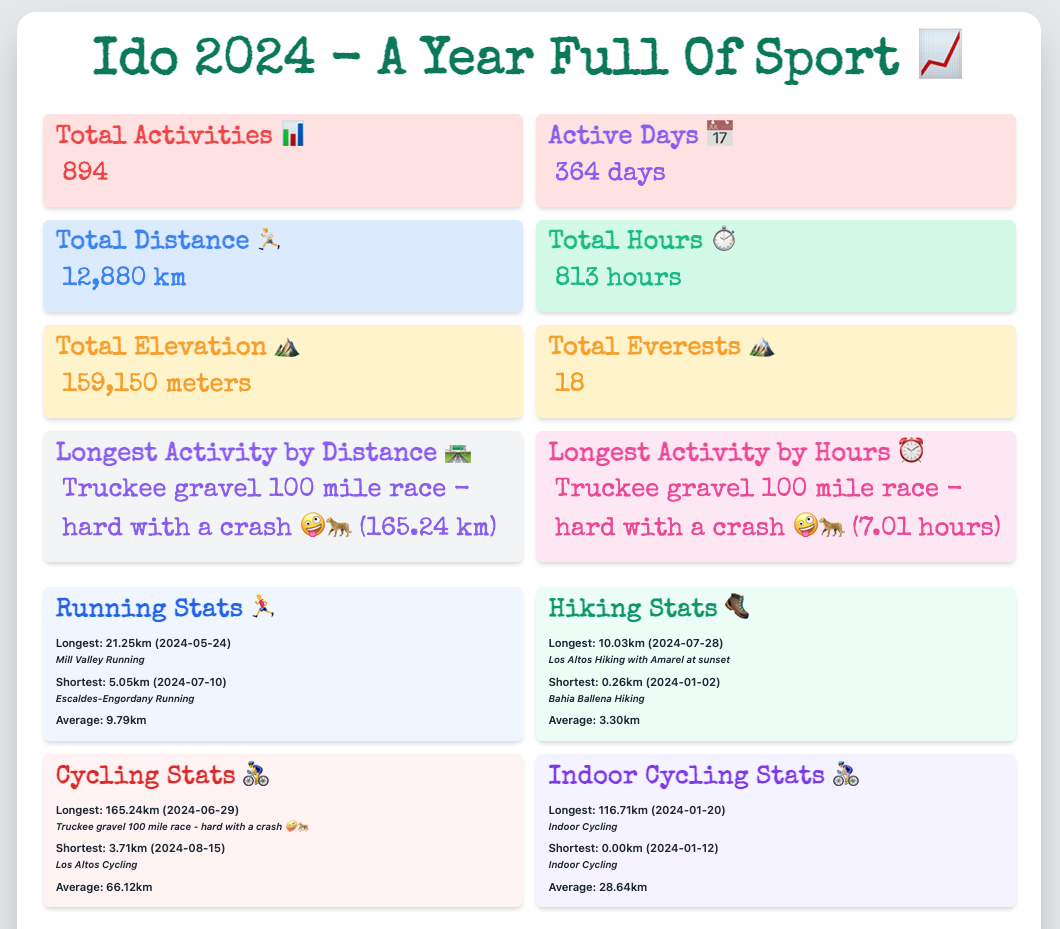
This year, the highlight of my racing calendar was the Truckee 100-mile gravel ride. While it might not demand the same rigorous training as an Ironman, it still requires significant time and effort to prepare physically and mentally. Unfortunately, the race wasn’t without challenges—midway through, I experienced a crash that could have derailed the day entirely. Yet, despite the setback, I managed to get back on my bike and cross the finish line.
Completing a goal race, especially under less-than-ideal circumstances, carries a sense of accomplishment that’s hard to put into words. It’s not just about the distance or the clock; it’s about the perseverance, grit, and commitment it takes to see something through to the end.
🥂 Here’s to many more events—hopefully crash-free!
2024 Books
It was a busy year. Between work (a new startup is on the way!) and the kids, I did my best to be out there and do some long runs/rides/hikes. The bonus is that it allows you to listen to (some good) books.
Here are some of the books I covered. As you can tell, it’s a mix of fiction (thank you, Daniel Silva, Lee Child, and Jack Carr) and non-fiction. Like other things in life, it’s best to mix things.
Portrait of a Spy/The English Girl/The English Spy/House of Spies (Daniel Silva)
Four books of Gabriel Allon being the James Bond of the art restoration world. Who knew touching up old paintings could lead to so much international intrigue?
Takeaway: Always keep your paintbrush sharp and your spy skills sharper.
Essentialism (Greg McKeown)
It’s about doing less but better, which is ironic because you must read the whole book to learn how to do less.
Ideas:
1) If it’s not a clear yes, it’s a no
2) You can’t have it all, but you can have what matters most
3 Jack Reacher Novellas (Lee Child)
Three shorter stories about a very tall man solving problems by being tall and punching things.
Takeaway: Sometimes, the best solution is being 6’5″ and knowing how to throw a right hook. But always think before you act. It helps.
Atomic Habits (James Clear)
How to build good habits and break bad ones, explained in a way that makes you feel bad about your morning routine.
Takeaway: You’re probably brushing your teeth wrong and not making sure your passwords are strong, but don’t worry, there’s a system for that.
The Terminal List (Jack Carr)
A thriller about revenge that makes John Wick look like a conflict resolution specialist. It’s a good one for long runs/hikes. Sort of 007 but for 2024.
Takeaway: Don’t mess with Navy SEALs who keep detailed lists.
Meditations (Marcus Aurelius)
Ancient Roman emperor’s diary entries make more sense now than most modern self-help books. It’s the 2nd time I’ve tried it. Not as easy as it sounds.
Takeaway: Even rulers of the known world had bad days at the office. Life is complicated.
The Women (Kristin Hannah)
A powerful historical fiction about women during the Vietnam War. It detailed the harsh ‘welcome’ they got back home and the challenges they needed to face.
Takeaway: War is ugly, and women did/do outstanding work.
Revenge of the Tipping Point/Outliers (Malcolm Gladwell)
Two books about how small things make big differences and how success isn’t always what it seems.
Takeaway: You’re either 10,000 hours away from mastery or one well-timed sneeze away from starting a revolution. It could go either way.
Hidden Potential (Adam Grant)
A book about how we’re all better than we think in ways we haven’t discovered yet. It’s like finding out you have a superpower, but it’s alphabetizing soup cans fast.
Ideas:
1) Character is more important than talent for long-term success
2) The “naturals” often peak early; the strivers win in the end
Shantaram (Gregory David Roberts)
A convicted criminal escapes prison and somehow ends up running a medical clinic in Mumbai’s slums. Makes your gap year look pretty tame.
Ideas:
1) Sometimes, your biggest mistakes lead to your greatest redemption
2) The best life lessons often come from the most unexpected teachers
Benjamin Franklin (Walter Isaacson)
The story of America’s most interesting founding father, who was basically the original lifestyle influencer with better inventions and worse Instagram filters.
Ideas:
1) Curiosity + pragmatism = innovation
2) Public image is carefully crafted art. Ben did personal branding before it became cool.
Super communicators (Charles Duhigg)
A deep dive into why some people can explain rocket science to five-year-olds while others can’t even order coffee without causing confusion.
Ideas:
1) The best communicators focus on what others understand, not what they know
2) Simple language beats fancy jargon every time
The Simulation Hypothesis (Rizwan Virk)
What if everything is just a really advanced video game? And who’s holding the controller?
Makes you want to try jumping twice to see if you can fly.
Ideas:
0) We live in a simulation. Yes – The Matrix is accurate.
1) Reality might be more programmable than we think
2) The universe follows patterns suspiciously similar to game design
Unreasonable Hospitality (Will Guidara)
How making people feel special turned a restaurant into a legend.
Spoiler: It’s not just about the food; it’s about making memories (and probably folding some fancy napkins).
Ideas:
1) Over-the-top service creates unforgettable experiences
2) The smallest details often make the biggest impact
Shadow Divers (Robert Kurson)
Some guys find a mystery U-boat and get really obsessed with it. Like, “quit your job and risk your life” obsessed.
Ideas:
1) True passion makes impossible tasks possible
2) History’s most significant discoveries often come from amateurs who didn’t know when to quit
Profiles in Leadership (Walter Isaacson)
A collection of stories about leaders who changed history, proving that greatness comes in many forms, none of which involve your LinkedIn “thought leadership” posts.
Ideas:
1) True leadership emerges in moments of crisis
2) The best leaders balance vision with pragmatism
Prelude to Foundation/Foundation (Asimov)
A mathematician figures out how to predict the future of humanity through equations. Like weather forecasting, but for civilizations and with way more robots.
Ideas:
1) Individual actions can change the course of history
2) The best plans work even when people don’t know they’re part of them
The Queen’s Gambit (Walter Tevis)
A girl discovers she’s really good at chess and not so good at life. Being a prodigy doesn’t help you figure out life.
Ideas:
1) Genius often comes with a price
2) The most prominent opponent is usually yourself
The Art of War (Sun Tzu)
Ancient wisdom about winning battles applies to everything from business to sport.
Ideas:
1) The best victory is winning without fighting
2) Know yourself and your opponent equally well
The Innovators (Walter Isaacson)
The story of how computers went from room-sized calculators to pocket-sized everything-machines is told through the nerds who made it happen.
Ideas:
1) Innovation is usually collaborative, not solitary
2) The best inventions combine art and science
The Restaurant at the End of the Universe (Douglas Adams)
A hilarious romp through space where the answer is 42, but nobody remembers the question. Like a philosophy course taught by comedians on a spaceship.
Ideas:
1) The universe is absurd; you might as well enjoy it
2) The questions are more important than the answers
What We Owe the Future (William MacAskill)
A philosophical look at how today’s actions affect tomorrow’s world. Spoiler: we’re basically writing a very long letter to our great-great-grandkids.
Ideas:
1) Small choices today can have massive future impacts
2) Moral progress is not guaranteed but can be shaped
Human Compatible (Stuart Russell)
How do we make AI that won’t turn us into paperclips? A guide to keeping robots as friends, not overlords.
Ideas:
1) AI should be designed to be uncertain about human preferences
2) The real challenge isn’t intelligence; it’s alignment
Leonardo da Vinci (Walter Isaacson)
The story of history’s most famous polymath was basically that kid who doodles in class but became a genius in many fields, from art to medicine to the invention of tools we use hundreds of years later.
Ideas:
1) Curiosity about everything leads to innovation in anything
2) Perfect is the enemy of actually finishing things (e.g., Mona Lisa)
Elon Musk (Walter Isaacson)
“A Series of Fortunate Events Where an Awkward South African Kid Becomes Rich Enough to Make His Sci-Fi Dreams Everyone Else’s Problem.” The book chronicles Musk’s journey from coding games in his bedroom to launching cars into space because that’s what you do when you have rocket money. Isaacson spent two years following Musk around, probably wondering if Mars colonization plans count as a tax write-off.
Key takeaway:
The line between genius and chaos is apparently just a Twitter purchase away. Or, as Musk might say: “The best way to predict the future is to make everyone really nervous about what you might tweet next.”
“Foundation” (Asimov)
Psychohistorians try to save humanity through the power of long-term planning.
Key takeaway: The best way to predict the future is to make it so complicated that nobody can prove you wrong.
Commander-in-Chief (Tom Clancy)
Part of the Tom Clancy universe where apparently every global crisis happens simultaneously and can only be solved by people who know how to adequately describe military hardware. Top ideas: 1) The world’s fate always depends on one without enough sleep, 2) Every problem can be solved with the proper submarine, and 3) If you understand all the military acronyms, you might be a spy.
Turtles All the Way Down (John Green)
John proves you can write a deeply moving story about mental health while still sneaking in enough nerdy references to fill a Reddit thread.
Top ideas:
1) Everyone is fighting their own battles, even if you can’t see them
2) Star Wars fanfiction can be therapeutic
3) The real treasure is the anxiety we made along the way.
Killers of the Flower Moon
A true crime story that makes you realize that if someone suddenly becomes mysteriously wealthy in the 1920s, they’re probably not good at investing.
Top ideas:
1) The creation of the FBI wasn’t just about stopping bootleggers
2) Never trust anyone who suddenly wants to marry into your wealthy family
3) Sometimes, the most shocking part of history isn’t in your textbooks.
In Cold Blood (Truman Capote)
A masterpiece that makes you realize that true crime was before Netflix made it cool.
Top ideas:
1) The scariest stories are the true ones
2) Sometimes the most essential character is the writer himself
3) Small towns have the most significant secrets.
🎉 Have a productive 2025!
Discover more from Ido Green
Subscribe to get the latest posts sent to your email.
 Ido Green
Pingback: Endurance and Insights: My 2024 in Books and Sports - CodeGurus