
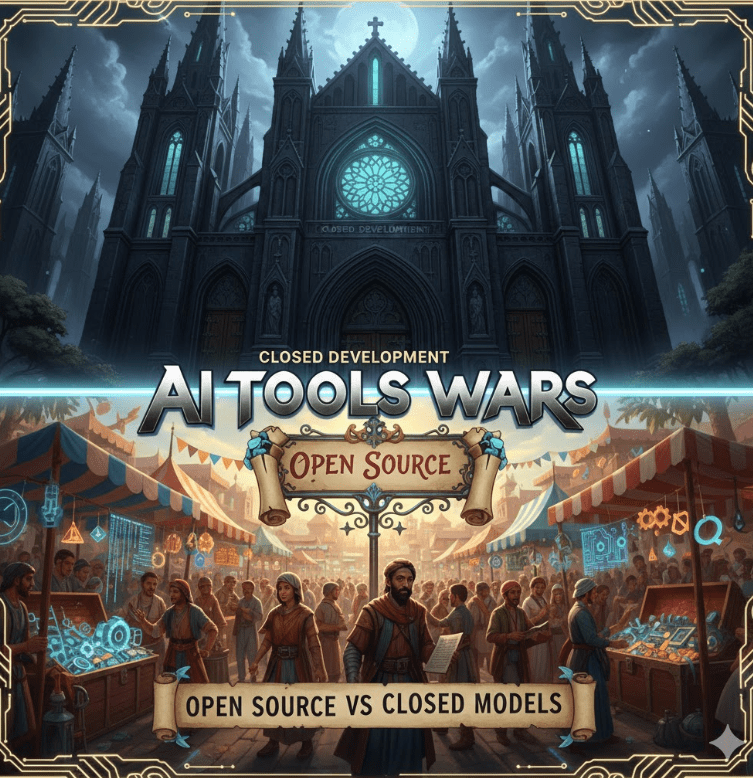
The AI tooling space has entered its loud phase.
Every week there’s a new “Copilot killer,” a leaked benchmark, or a dramatic Hacker News thread declaring that this model finally understands context / code / humanity. Under the noise, a real question matters to developers and teams:
Should we rely on closed AI tools, or is open source quietly winning where it counts?
This isn’t philosophy. It’s about velocity, trust, cost, and control.
Let’s ground this in actual developer work.
Closed Models: Fast, Polished, And Slightly Opaque
Closed models like GPT-5.x, Claude 4.5, and Gemini 3.x pro feel magical when they work.
They tend to win on:
- Strong reasoning across mixed contexts (code + prose + product thinking)
- High-quality UX and integrations
- Aggressive iteration and model improvements
If you’re doing things like:
- Refactoring large legacy codebases
- Generating PR summaries or architectural explanations
- Pair-programming on unfamiliar domains
Closed models still have an edge.
Claude, for example, is excellent at reading large files and producing coherent refactors.
GPT shines when you need structured output with constraints.
Gemini is very powerful and I’m using it daily.
But there are tradeoffs that show up quickly in real teams.
Where Closed Tools Hurt
Context limits are still real, even if they’re marketed as “huge.”
Data leaves your boundary — which matters more as soon as you touch customer code or regulated domains.
Behavior changes silently. A prompt that worked last week may degrade after a model update.
Cost scales non-linearly. What feels cheap for one developer becomes noticeable for a team.
The biggest issue isn’t price or privacy.
It’s lack of control.
You’re building workflows on a moving surface.
Open Source Models: Less Flash, More Leverage
Open models (LLaMA-derived, Mistral, DeepSeek, Qwen, etc.) don’t usually win benchmarks.
That’s not the point.
They win where software actually lives: inside systems.
If you self-host or run them via tools like Ollama, LM Studio, or vLLM, you gain:
- Deterministic behavior
- Full data ownership
- Custom fine-tuning or prompt specialization
- Predictable cost
This changes how you use AI.
Example 1: Repo-Aware Code Assistant
Instead of asking a closed model to “understand my project,” you can:
- Index your repo with embeddings
- Route only relevant files into context
- Enforce strict response formats
- Run the same model version for months
Suddenly, the AI stops being a chat buddy and becomes infrastructure.
Less impressive demos. More reliable output.
Example 2: CI-Level Intelligence
Teams are starting to use open models to:
- Review PRs for risky patterns
- Enforce architectural rules
- Detect copy-paste vulnerabilities
- Flag test gaps based on code diffs
This is boring work. Which is exactly why it’s valuable.
You don’t need GPT-level brilliance to catch a missing null check or an unsafe SQL pattern.
You need consistency.
The Hybrid Pattern Is the Winner
The most effective setups I’m seeing are hybrid:
Closed models for:
- Exploration
- Design discussions
- One-off refactors
- Human-facing explanations
Open models for:
- Repetitive engineering tasks
- CI/CD hooks
- Security checks
- Long-running internal tools
Think of closed AI as a senior consultant and open AI as a staff engineer that never leaves.
A Reality Check on “Productivity”
AI doesn’t make developers 10x faster.
It removes friction from:
- Switching contexts
- Writing boilerplate
- Remembering internal conventions
- Explaining code to humans
The real productivity gain comes when:
- Prompts are versioned
- Outputs are validated
- AI results are treated like untrusted input
- Tooling is embedded in workflows, not chats
If your AI lives only in a sidebar, you’re leaving most of the value on the table.
Practical Suggestions If You’re Building or Leading
Don’t standardize on one model. Standardize on interfaces.
Measure usefulness, not hype.
Track what actually saves time.
Treat AI output like junior code: helpful, fallible, reviewable.
Prefer boring reliability over impressive demos.
Invest early in prompt hygiene and guardrails.
The teams getting real value from AI aren’t chasing the “best model.” They’re building systems that assume models will change — and designing accordingly.
The Quiet Truth
Open source AI won’t win glossy benchmarks.
But it’s slowly becoming the backbone of serious developer tooling — the kind that runs every day, touches real code, and doesn’t ask permission to exist.
That’s usually how infrastructure wins.
Discover more from Ido Green
Subscribe to get the latest posts sent to your email.
 Ido Green